ASUS Vivobook S14 vs. HP EliteBook 840 G8 (2026): Consumer Ultrabook vs. Business Workhorse
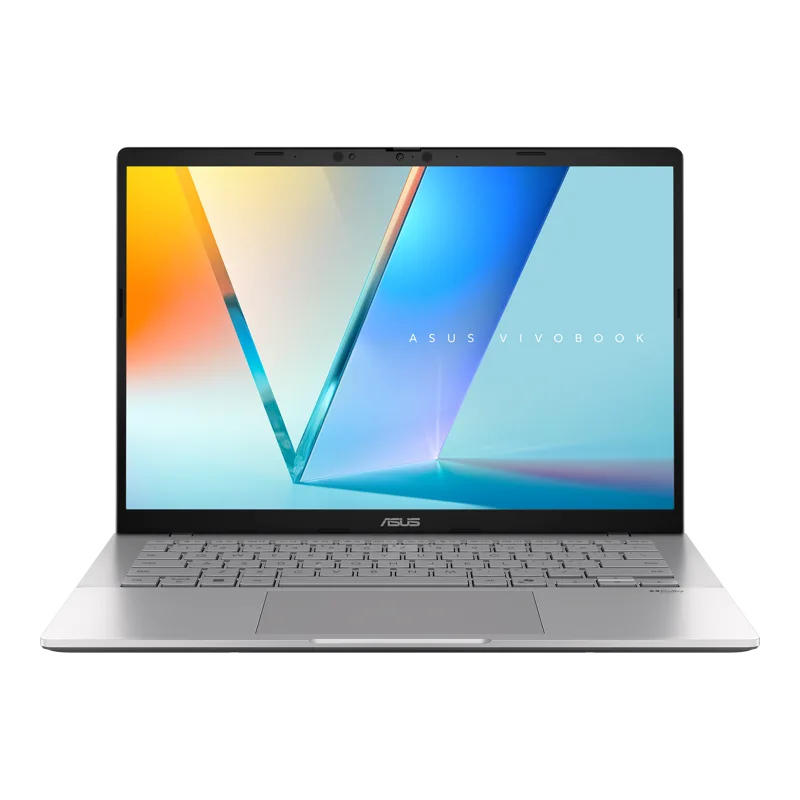
Not every laptop comparison is about gaming benchmarks. The ASUS Vivobook S14 and the HP EliteBook 840 G8 both land in our catalog as 14-inch productivity machines, but they were designed for almost opposite buyers: one is a modern consumer ultraportable built around the newest silicon money can buy, the other is a business-fleet workhorse built around manageability, security, and IT-department longevity. Cross-shopping them only makes sense once you know which of those two worlds you actually live in.
The hardware, side by side
The Vivobook S14 runs an AMD Ryzen AI 9 HX 370, a 12-core chip with integrated AMD Radeon 890M graphics, paired with up to 32GB of LPDDR5X memory and up to 1TB of PCIe SSD storage, all driving a 14-inch 3K (2880x1800) 120Hz OLED panel with HDR. The EliteBook 840 G8 is built around an older but still capable Intel Core i7-1185G7 with vPro management features, Intel Iris Xe integrated graphics, up to 32GB of DDR4 memory, up to 2TB of NVMe storage, and a more conventional 14-inch FHD (1920x1080) IPS display. The generational gap between the two platforms is real — the Vivobook launched years after the EliteBook — and it shows across nearly every spec.
Display: OLED 3K vs. FHD IPS
This is the starkest difference between the two. The Vivobook's 3K OLED panel delivers true blacks, wide color coverage, and roughly 2.25x the pixel density of the EliteBook's 1080p IPS screen, making it dramatically better for photo editing, streaming, or simply looking at all day. The EliteBook's FHD IPS panel is perfectly serviceable for spreadsheets, email, and video calls — the bread and butter of office work — but it's a generation behind on what a premium 14-inch display can offer in 2026.
Performance and everyday responsiveness
The Ryzen AI 9 HX 370's 12 cores and newer architecture give the Vivobook a meaningful edge in multi-threaded workloads like batch photo processing or video export, and its Radeon 890M integrated graphics handle light gaming and GPU-accelerated creative apps noticeably better than the EliteBook's Iris Xe. The EliteBook's 4-core i7-1185G7 was a strong chip for office productivity in its day and remains fine for browser tabs, documents, and video calls, but it's not the machine to reach for if your workload leans on multi-core performance.
Business features: what the EliteBook still wins
Raw performance isn't the whole story. The EliteBook 840 G8's Intel vPro platform brings remote manageability, hardware-level security features, and fleet-deployment tools that IT departments specifically buy HP's EliteBook line for — features the consumer-focused Vivobook simply doesn't offer. If your laptop needs to be centrally managed across dozens or hundreds of employees, or needs to meet a specific corporate security compliance bar, the EliteBook's vPro support is a genuine differentiator that no amount of Vivobook spec-sheet advantage changes.
Battery life and portability
The Vivobook S14 carries a 75Wh battery in a 1.3kg chassis, and its more efficient AMD silicon combined with that larger cell typically translates into longer unplugged time than the EliteBook's smaller 53Wh battery, even accounting for the EliteBook's slightly lighter 1.32kg-class build. For anyone who works away from a charger for long stretches, the newer platform's efficiency gains are a real practical advantage, not just a spec-sheet number.
Build quality and design language
The Vivobook S14 wraps its modern internals in a slim aluminum-alloy chassis under 1.3kg, aimed squarely at buyers who want a premium feel without a premium ultrabook price tag. The EliteBook 840 G8 takes a different design brief entirely: a MIL-STD-810H tested chassis built to survive years of being packed in a bag, shipped across a corporate fleet, and repaired by an IT department rather than replaced — a spill-resistant keyboard and reinforced hinges matter more to that buyer than a thin-and-light silhouette. Neither is objectively better built; they're built for different kinds of abuse.
Ports, webcam, and the working-from-anywhere experience
Both being 14-inch business-adjacent laptops rather than ultra-thin travel machines, each offers a reasonably complete port selection for the era it launched in — expect USB-C, USB-A, and HDMI on both, with the EliteBook additionally offering the kind of docking-station compatibility that corporate IT departments standardize around for hot-desking setups. Webcam and microphone quality matter more than ever for remote and hybrid work, and both platforms support the video-conferencing basics well enough for daily meetings, though neither is a standout in that specific category the way some newer flagship business laptops now are.
Price and value today
At $1,099, the Vivobook S14 undercuts most premium ultrabooks while delivering a genuinely current-generation display and CPU platform — it's hard to find a better display-per-dollar in this class. The EliteBook 840 G8, as an older business-fleet model, is typically found well below its original launch price on the refurbished and enterprise-surplus market, which is exactly where it makes the most sense: as a cheap, well-supported, secure Windows machine for basic office work, not as a display or performance showcase.
Who should actually buy which
Buy the Vivobook S14 if you want the best possible display and CPU for the money in a 14-inch consumer laptop, and don't need centralized IT management. Buy the EliteBook 840 G8 if you're outfitting a business fleet that needs vPro manageability and security compliance, and you're comparison shopping in the refurbished or enterprise-surplus market rather than against brand-new consumer ultrabooks — comparing it dollar-for-dollar against a new Vivobook S14 isn't really a fair fight, since the two were never competing for the same buyer or the same era of hardware.
Our verdict
This comparison ultimately comes down to what "value" means for your situation. For an individual buyer prioritizing display quality and modern performance, the Vivobook S14 is the clearly stronger machine on nearly every spec that matters day to day. For an IT manager outfitting a fleet where manageability, security compliance, and total cost of ownership matter more than having the newest OLED panel, the EliteBook 840 G8's vPro platform and business-first design still justify its place in the market, even years after launch. We cover more business-focused options, including newer alternatives to the EliteBook, in our business laptop showdown.