ASUS ROG Strix G16 (2025) Review: A 240Hz Gaming Laptop That Doesn’t Cut Corners
8.6/10
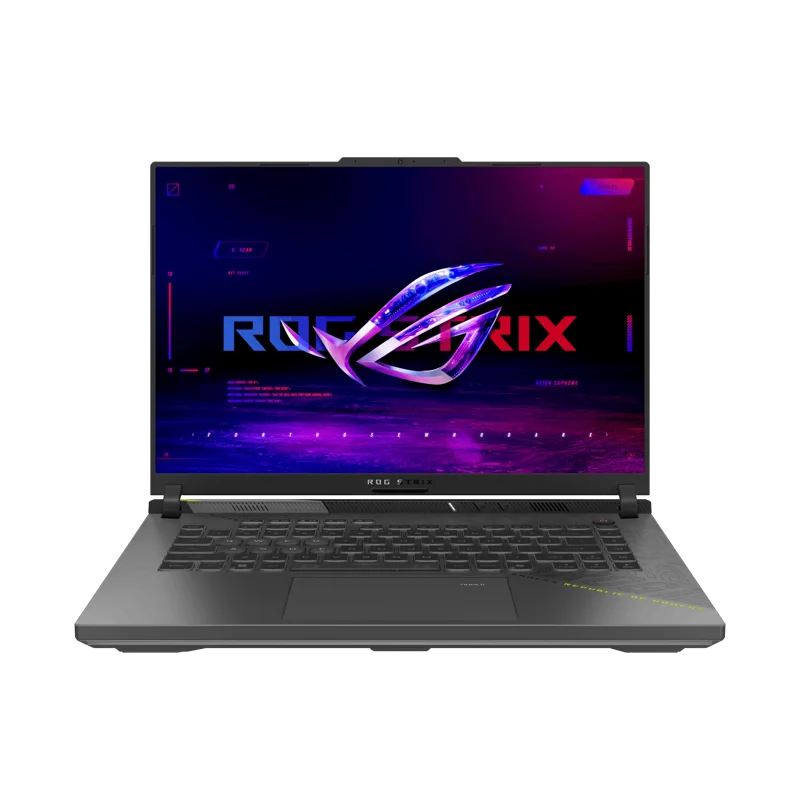
The 2025 ASUS ROG Strix G16 (model G614) sits in an interesting spot in ASUS's gaming lineup: not as boutique or as expensive as the Zephyrus line, but far more serious than a budget gaming laptop pretending to play in the same league. At $1,899, it pairs an AMD Ryzen 9 9955HX3D — a 16-core chip that leans on 3D V-Cache to punch above its clock speed in games — with an NVIDIA GeForce RTX 5070 carrying 8GB of GDDR7. On paper that's a genuinely modern combination, and in day-to-day use it behaves like one: this is a laptop that stays composed at settings a lot of "gaming laptops" quietly can't sustain once the chassis heats up.
Display: the reason to pick this over a cheaper 1080p rival
The headline spec for anyone shopping this segment is the display: a 16-inch 2.5K panel (2560x1600) running at 240Hz with G-Sync, and it is the single best reason to pick the Strix G16 over cheaper 1080p/165Hz alternatives. Text is noticeably sharper on the Windows desktop, and in motion the extra resolution doesn't cost you the frame rate the way it can on some 4K gaming panels — 2.5K is a genuinely well-chosen middle ground for a 16-inch RTX 5070 machine, since the GPU can actually push competitive frame rates at that resolution in most titles rather than needing DLSS crutch mode at all times. G-Sync support means the panel and GPU stay in lockstep even when frame rates dip below the panel's max refresh, which matters more in practice than the raw 240Hz number by itself.
Design, build, and the everyday details
ASUS's Strix line has leaned into a more aggressive gamer-first design language than the Zephyrus family, and the G16 continues that with an AniMe Matrix-style lid panel on higher configurations and RGB lighting on the keyboard deck. It won't be to everyone's taste if you want something more understated for an office or a coffee shop, but the chassis itself — mostly plastic with some metal reinforcement around the deck — feels solid rather than flexy, which isn't always true at this price point. Port selection is generous for a 16-inch gaming laptop: a full-size HDMI output, multiple USB-A ports, USB-C with DisplayPort support, and a headphone jack, so you're unlikely to need a dongle for most peripherals or an external monitor.
Memory: the one spec that reads conservative
16GB of DDR5-5600 is the one spec here that reads a little conservative for a $1,899 gaming laptop in 2025 — it's enough for gaming today, but if you also run background capture software, a browser with forty tabs, and a game at the same time, you'll feel it sooner than you would on a 32GB config. The saving grace is that ASUS left the RAM expandable up to 64GB rather than soldering it, so it's a fixable problem rather than a permanent ceiling, unlike laptops that solder memory in at the factory. If your budget allows it, we'd recommend budgeting for a RAM upgrade at purchase time rather than waiting until you hit the ceiling in a stressful moment mid-session.
Battery life and thermals
Battery life on a 240Hz IPS panel pushing an RTX 5070 was never going to be a strong suit, and ASUS doesn't pretend otherwise — the 90Wh cell gets you through general browsing and writing, but plan on the charger being nearby for anything sustained, and expect gaming battery life to be measured in a small number of hours rather than a full workday. Under sustained gaming load, the cooling system does its job of keeping clock speeds reasonably stable, though as with most thin-and-not-quite-thin 16-inch gaming chassis, fan noise becomes noticeable once you push the GPU hard — a pair of headphones is a good idea for anything beyond casual play. At 2.5 kg it's also not a laptop you forget is in your bag, though that's fairly normal for the 16-inch gaming category and lighter than many rivals with comparable GPU tiers.
How it compares, and who should buy it
If you want most of what the Strix G16 offers in a considerably lighter and more travel-friendly shell, it's worth cross-shopping ASUS's own ROG Zephyrus G14, which trades some raw GPU headroom for a 14-inch OLED panel and roughly a kilogram less weight. If you specifically want the newest GPU tier and don't mind paying a flagship premium, the Razer Blade 16 (2026) steps up to an RTX 5070 Ti and an OLED panel, at close to double the price.
Ports, webcam, and the software experience
Connectivity on the Strix G16 covers the essentials well: full-size HDMI 2.1, a couple of USB-A 3.2 ports, USB-C with DisplayPort and power delivery, a 2.5Gbps Ethernet jack (a genuinely useful inclusion for anyone gaming online over a wired connection), and a microSD reader. The 1080p webcam is serviceable for video calls without being a highlight. On the software side, ASUS's Armoury Crate handles fan curves, RGB lighting, and GPU switching between integrated and discrete graphics — it's more capable than most OEM utility apps, though it can feel cluttered compared to a clean Windows install, and some buyers prefer to disable the more intrusive background services it installs.
Longevity: how well this configuration should age
Because ASUS left the RAM slots accessible rather than soldering memory to the board, the Strix G16 has a genuinely longer useful lifespan than many rivals at this price — when 16GB starts feeling tight in two or three years, a straightforward RAM upgrade extends the machine's comfortable service life without needing to replace the whole laptop. The same logic applies to storage: the single M.2 slot in most Strix G16 configurations leaves room for a second NVMe drive down the line if 1TB stops being enough, something that's not possible on many thinner, more soldered competitors. Combined with a 16-core CPU that's unlikely to become a bottleneck before the GPU does, this is a laptop built with a reasonable upgrade path in mind, not a fixed appliance you replace wholesale the moment one spec falls behind.
Verdict: The ROG Strix G16 (2025) is a well-balanced pick for anyone who wants a genuinely high refresh-rate, higher-resolution gaming laptop without stepping up into $2,500+ territory, as long as you go in accepting that 16GB of RAM is a starting point, not a final answer.
See the full spec sheet and current price on our ROG Strix G16 (2025) product page.