Desktop vs. Laptop for Gaming in 2026: NZXT Player: Three vs. ASUS ROG Strix G16
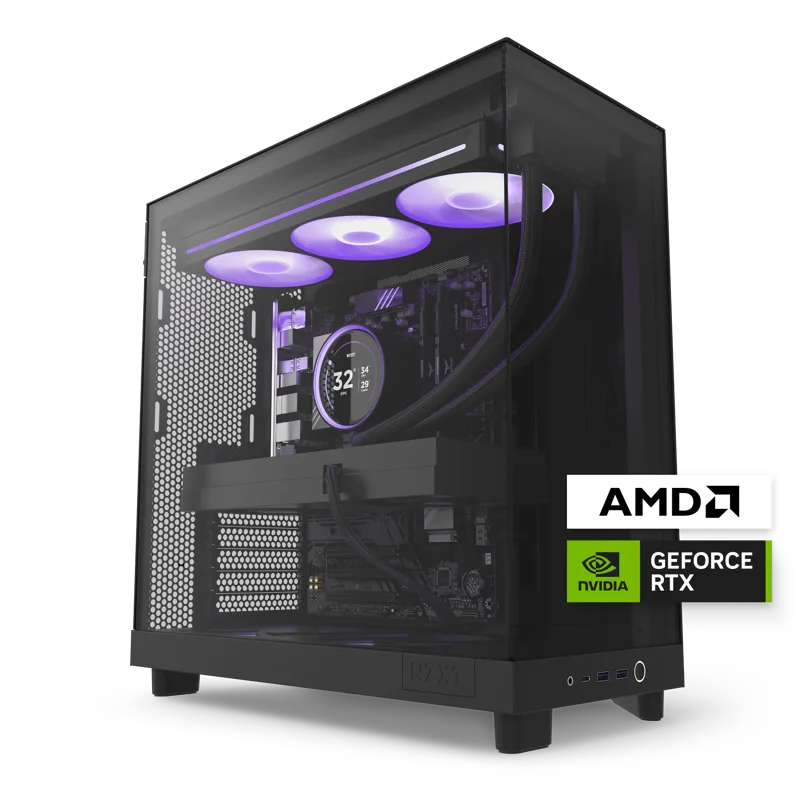
Both of these are genuinely good gaming machines from our catalog, but they represent the two fundamentally different answers to the same question: do you want maximum performance in a box that stays on your desk, or performance you can take anywhere? The NZXT Player: Three desktop and the ASUS ROG Strix G16 laptop sit at similar price points and both target serious gamers, which makes them a genuinely useful head-to-head for the form-factor decision itself.
The raw performance gap
The Player: Three runs a desktop NVIDIA GeForce RTX 5080 with 16GB of VRAM alongside an 8-core Ryzen 7 9800X3D — a combination with no meaningful thermal or power constraints, cooled by a full-size liquid AIO in a case with unrestricted airflow. The Strix G16 runs a mobile RTX 5070 with 8GB, power-limited by laptop thermal and battery constraints, paired with a 16-core Ryzen 9 9955HX3D. Despite the Strix G16 technically having more CPU cores on paper, the desktop's combination of a higher GPU tier and zero power throttling gives the Player: Three a clear, measurable performance advantage at both 1440p and especially at 4K, where the extra VRAM and unrestricted GPU power budget matter most. For exactly why a laptop GPU underperforms its desktop namesake even at the same tier, see our laptop vs. desktop GPU explainer.
Price: the desktop wins on performance per dollar
The Player: Three lists at $3,799; the Strix G16 lists at $1,899. On the surface that looks like a huge price gap in the laptop's favor, but per unit of gaming performance delivered, the desktop is actually the better value — you're paying a premium for portability with the laptop, not getting a discount. If raw price-to-performance is your only metric and you don't need to move the machine, the desktop wins comfortably even before factoring in the higher sticker price of the laptop relative to its GPU tier.
Where the laptop actually wins: everything involving movement
None of this makes the Strix G16 a bad choice — it makes it a different choice. A gaming laptop goes to a friend's house, a LAN party, a dorm room, or simply a different room of your own home without any setup beyond opening the lid. It has a built-in display, keyboard, and battery, none of which the Player: Three has at all — the desktop needs a monitor, keyboard, mouse, and a permanent desk setup to be usable at all. If your gaming happens in more than one physical location, or you don't have room for a dedicated desktop setup, the laptop's portability isn't a minor convenience, it's the entire point of buying it.
Noise and thermals in practice
The Player: Three's full-size liquid cooling keeps it quieter under sustained load than the Strix G16 can manage in its 16-inch chassis, where the fans have to work harder in a much smaller volume to dissipate similar heat. Neither is unpleasantly loud, but if you game late at night in a shared space, the desktop's cooling headroom gives it a real edge in staying quiet at load — a laptop simply has less room for large fans and radiators, and that physical constraint doesn't go away no matter how well a manufacturer engineers the chassis.
Upgrade path: a genuine long-term difference
This is one of the starkest differences between the two form factors. The Player: Three is built on a standard ATX platform — when the next GPU generation launches, swapping the graphics card is a straightforward afternoon project, the same as it would be on any self-built desktop. The Strix G16's GPU is soldered to the motherboard and cannot be upgraded at all; when it's time for more performance, the entire laptop gets replaced. Over a five-year ownership window, that difference in upgrade flexibility can represent thousands of dollars in avoided replacement cost for the desktop owner.
Storage and memory: both generous, one is more expandable
Both systems ship with 32GB of memory, which is a sensible amount for gaming alongside typical background applications on either machine. Storage favors the desktop meaningfully — the Player: Three's 4TB NVMe SSD dwarfs the Strix G16's 1TB drive, and while the laptop's storage can be replaced or supplemented if you're comfortable opening the chassis, the desktop's standard ATX layout makes adding a second or third drive later a trivial, tool-light task. For anyone with a large modern game library, that storage gap alone is a meaningful practical consideration independent of raw GPU performance.
The battery question nobody asks about a desktop
It's easy to forget this is even a variable, but it matters: the Strix G16 can genuinely run away from a wall outlet for a few hours of lighter, non-gaming use thanks to its 90Wh battery, even though heavy gaming will drain it in well under two hours. The Player: Three has no battery at all — a power outage mid-session means an instant, unsaved loss of progress on the desktop unless you're also running a separate UPS, an extra cost and an extra box to find room for. For anyone who has ever lost unsaved work to a power blip, that's a real, if easily overlooked, advantage on the laptop's side of the ledger.
Which one should you actually buy?
If you have a dedicated gaming space, value maximum performance per dollar, and want a GPU upgrade path for the future, the Player: Three desktop is the stronger choice, and it isn't particularly close on raw performance. If you need to game in multiple locations, don't have room for a permanent desktop setup, or simply want one device that handles gaming and everyday portable computing in a single machine, the Strix G16 earns its premium by doing something the desktop structurally cannot: leaving the room with you. Most buyers already know which category they fall into before reading a single spec — the honest question to ask yourself first is whether the machine needs to move, not which GPU number sounds more impressive on a shelf.