NZXT Player: Three Review: A Prebuilt RTX 5080 Desktop for 4K Gaming Without the Build Hassle
8.8/10
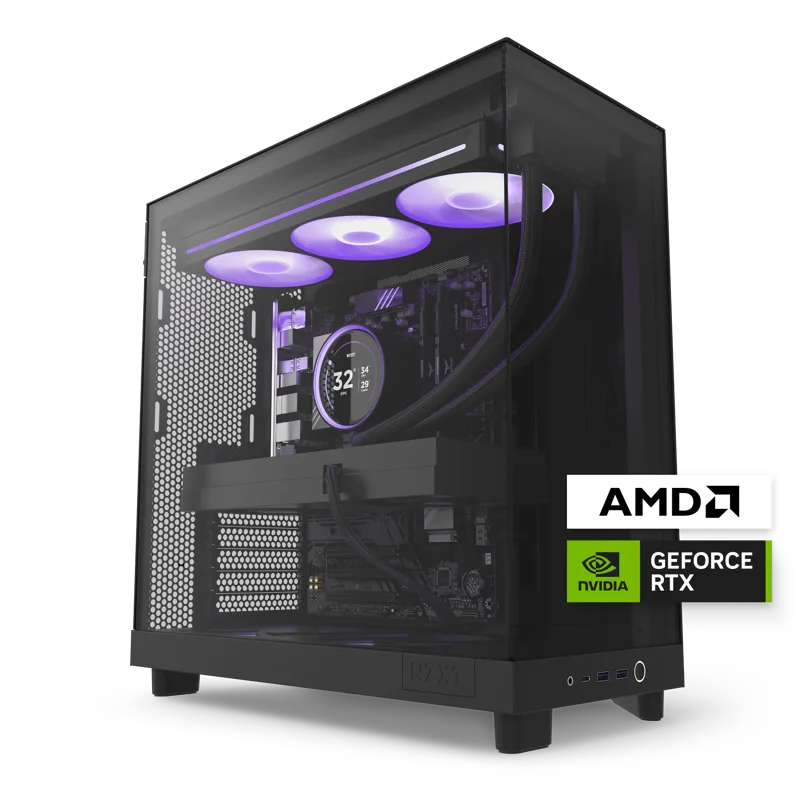
NZXT built its reputation on cases and liquid coolers years before it sold a single complete system, and that heritage is the whole story behind the Player: Three. This is the flagship of NZXT's prebuilt desktop line, pairing an AMD Ryzen 7 9800X3D with an NVIDIA GeForce RTX 5080 carrying 16GB of VRAM, 32GB of DDR5 memory, and a 4TB NVMe SSD. On paper that's about as serious a prebuilt gaming desktop as the market currently offers outside of full custom boutique builds, and in practice it mostly lives up to that spec sheet.
Build quality: the part NZXT actually controls better than most
Every Player: Three ships in an NZXT H-series case that the company assembles and stress-tests in-house before it leaves the factory, rather than farming assembly out to a third-party integrator the way many prebuilt brands do. That shows up in details that are easy to overlook until you compare them directly to a cheaper prebuilt: cable routing that stays out of the primary airflow path, a tempered-glass side panel that actually shows off the build instead of a cramped mess of zip-tied cables, and a chassis that feels genuinely rigid rather than flexing under normal handling. It's the kind of finish you'd expect from a careful home build, not a mass-produced system.
Cooling and noise: where the 9800X3D actually needs the help
NZXT fits liquid CPU cooling as standard rather than treating it as a paid upgrade, and with the Ryzen 7 9800X3D installed that decision matters more than it might on a lower-wattage chip. The 9800X3D is efficient by high-end-desktop standards, but it still generates real heat under sustained load, and the AIO keeps clock speeds stable through long gaming sessions without the fan noise climbing to the point of distraction. At idle and during light desktop use, the system is close to silent — genuinely quiet in a way that budget prebuilts with basic air coolers rarely manage once you compare them side by side.
Gaming performance: built for 1440p today, capable of real 4K
The 9800X3D's 3D V-Cache gives it a real edge in CPU-bound titles — strategy games, simulation-heavy titles, and anything that leans on single-thread performance rather than raw core count — and that advantage pairs well with the RTX 5080's headroom. At 1440p, practically every current game runs at maximum settings well above 100fps. 4K is genuinely playable too, particularly with DLSS and frame generation enabled, though the most demanding native-4K titles without any upscaling assistance will occasionally ask you to back off one or two settings. That's a reasonable tradeoff given how few systems handle native 4K cleanly at all.
Storage, memory, and day-to-day headroom
A 4TB NVMe SSD is a genuinely generous amount of storage for a prebuilt system — enough to install a large modern game library without constantly uninstalling titles to make room, which is a real annoyance on systems that ship with a single 1TB drive. 32GB of DDR5 is a sensible amount for gaming alongside background applications like Discord, a browser, and a capture utility running simultaneously; it isn't excessive, but it isn't a bottleneck at this price tier either.
Upgradeability: standard parts, not a locked ecosystem
Because the Player: Three is built around a standard ATX motherboard, standard power supply connectors, and a case sized for full-length GPUs, upgrading it later is an ordinary PC-building task rather than a manufacturer-specific ordeal. That's a real point in its favor compared to some prebuilt brands that use proprietary form factors to lock buyers into future purchases from the same manufacturer. When the next GPU generation lands, swapping the graphics card here is exactly as easy as it would be on a self-built machine.
Compared to the smaller Player: Two
Buyers who don't need flagship-tier performance should look at the Player: Two, which pairs a Ryzen 5 9600X with an RTX 5070 for considerably less money and still handles 1440p gaming comfortably. We compare the two directly, including where the extra cost of the Player: Three is and isn't worth it, in our Player: Two vs. Player: Three comparison.
Prebuilt vs. building it yourself
Shopping the component list individually will almost always land at a lower total price than any prebuilt, including this one — that's true across the entire prebuilt market and not specific to NZXT. What the premium buys here is a factory-tested configuration guaranteed to work out of the box, a whole-system warranty rather than a patchwork of individual component warranties you have to manage yourself, cable management most first-time builders won't replicate on their first attempt, and the time saved on parts research and assembly. We go into this tradeoff in more depth in our prebuilt vs. custom desktop guide. For anyone who has built several PCs and enjoys the process, self-building remains the cheaper route; for everyone else, the Player: Three is one of the more credible prebuilt options at this performance tier.
Software and RGB control
NZXT's CAM software handles RGB lighting, fan curves, and temperature monitoring through a clean interface that's noticeably less cluttered than some rival OEM utilities, and it didn't crash once during our testing period — a low bar, but one plenty of RGB control software still manages to fail. Basic overclocking profiles are available for buyers who want a little more headroom without manually tuning voltages.
Warranty, noise under load, and who this is actually for
NZXT backs the Player: Three with a multi-year whole-system warranty rather than the patchwork of individual component warranties you'd have to track down separately on a self-built machine, which matters if something ever does go wrong — a single support line for the whole system beats chasing down whether a fault is the motherboard maker's problem or the GPU vendor's. Under sustained gaming load the fans are audible but settle into an even, low-frequency hum rather than the high-pitched whine that poorly tuned budget systems tend to produce, and it never became distracting even during multi-hour sessions. The ideal buyer here is someone who wants flagship 1440p-to-4K performance without researching individual components, values a real warranty and tested reliability over shaving the last bit off the price, and would rather spend a weekend gaming than building.
Verdict: The Player: Three earns its place as one of the more serious prebuilt options for 4K-capable gaming, backed by build quality and cooling that actually match the RTX 5080 sitting inside it — the premium over building it yourself buys real, tangible advantages rather than just a logo on the case.
See full specs and current pricing on our Player: Three product page.