Integrated Graphics for Gaming in 2026: Intel Arc, AMD Radeon 890M, and Apple GPU Compared
Integrated graphics used to mean "can't game." That's no longer true. Intel Arc integrated graphics, AMD's Radeon 890M, and Apple's in-house GPU cores have each closed a meaningful chunk of the gap that used to separate integrated graphics from entry-level discrete GPUs, to the point where a genuinely thin, fanless-or-near-silent laptop can now handle esports titles and moderately demanding games at reasonable settings. This guide looks at what's actually changed, using real integrated GPU platforms currently shipping in laptops, and where the remaining limits are.
Why integrated graphics improved so much
Three things moved at once: chipmakers dedicated more silicon area to graphics cores rather than treating them as an afterthought bolted onto a CPU die, memory bandwidth improved significantly with faster LPDDR5X standards (since integrated graphics share system memory rather than having dedicated VRAM), and driver software matured enough to extract more real-world performance from the same hardware over time. The combined effect is that a laptop with no discrete GPU at all can now deliver a genuinely usable gaming and creative experience, not just a technically-functional one, which simply wasn't true five years ago.
Intel Arc: a from-scratch integrated GPU architecture
Intel built Arc as a clean-sheet graphics architecture rather than an incremental update to its older integrated graphics, and it shows. The Zenbook 14 OLED pairs an Intel Core Ultra 9 285H (16-core) processor with Intel Arc integrated graphics, and the combination is capable of handling a wide range of modern games at 1080p with reduced settings, along with GPU-accelerated creative tasks like video encoding and photo editing that lean on dedicated hardware encode/decode blocks rather than pure shader performance. It's not a replacement for a discrete gaming GPU, but it's a legitimate step up from older integrated graphics that struggled with anything beyond basic desktop use.
AMD Radeon 890M: strong performance-per-watt
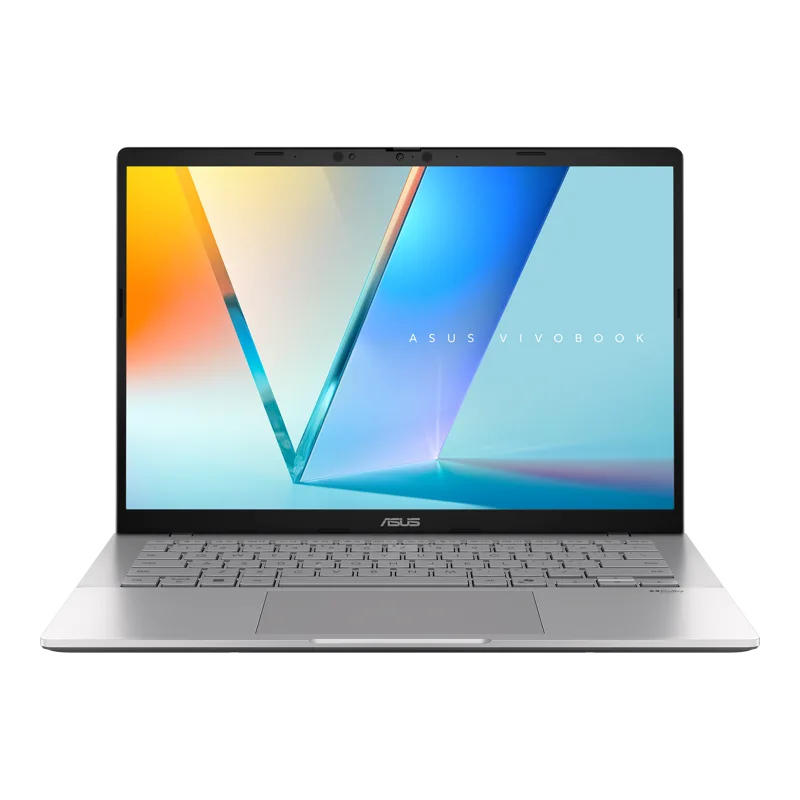
AMD's approach with Radeon 890M, found in the Vivobook S14 alongside an AMD Ryzen AI 9 HX 370 (up to 12-core) processor, focuses on strong performance-per-watt, which matters enormously in a thin laptop with a small cooling system and a battery to protect. Radeon 890M consistently ranks among the strongest integrated GPU options available in the current generation of thin-and-light laptops, capable of running many esports titles at solid frame rates and handling more demanding games at reduced settings. Because it doesn't need to power a separate discrete GPU chip, laptops built around it can also be thinner, lighter, and quieter than discrete-GPU alternatives, at the cost of a firm ceiling on maximum gaming performance.
Apple's integrated GPU: a different design philosophy entirely
Apple's approach is architecturally distinct from the Windows-laptop integrated GPU story. The MacBook Air's Apple M2 (8-core: 4 performance + 4 efficiency) chip includes an integrated GPU built on Apple's own unified memory architecture, where the CPU and GPU share the same extremely fast memory pool rather than the CPU and GPU competing for slower, more conventional system RAM bandwidth. This gives Apple's integrated graphics genuinely strong performance for creative workloads — video editing and photo processing in particular — though native gaming support remains the weaker side of the equation compared to Windows, since far fewer AAA titles are built and optimized for macOS. For creative work specifically, Apple's integrated GPU punches well above what its power draw would suggest; for gaming specifically, Windows-based integrated options currently offer a broader and better-optimized game library.
What integrated graphics still can't do
The remaining gap between integrated and discrete graphics is real and worth being honest about. Demanding AAA titles at high settings and high resolutions, sustained ray tracing, and VRAM-hungry creative workloads like large 3D scenes still meaningfully favor discrete GPUs with dedicated video memory. Integrated GPUs share system RAM with the CPU rather than having their own fast dedicated VRAM pool, which becomes a real bottleneck the moment a workload's memory needs grow past what a shared pool can comfortably handle at speed. For anyone whose primary use case is competitive esports, older or moderately demanding titles, and everyday creative work, integrated graphics in 2026 are a legitimately good choice. For anyone chasing the newest AAA titles at high settings, a discrete GPU is still the right call, and that gap is unlikely to fully close in the near term given how much dedicated VRAM and raw shader throughput a discrete card can bring to bear compared with graphics that have to share memory bandwidth with the rest of the system.
What buyers should actually check before comparing numbers
Marketing slides love to show integrated GPUs "beating" older discrete cards in a cherry-picked benchmark, but the honest way to evaluate an integrated GPU for a specific purchase is to look at the exact games or applications you'll actually run, at the resolution and settings you'll actually use, rather than a generic performance tier claim. Battery life under sustained graphics load is another number worth checking directly — integrated GPUs draw power from the same battery budget as the CPU, so a laptop that looks efficient in light productivity use can drain noticeably faster once its integrated graphics are under sustained load during a game or render. It's also worth checking how much system RAM is installed and at what speed, since integrated graphics performance scales directly with available memory bandwidth in a way discrete GPUs with dedicated VRAM simply don't — a laptop with faster, higher-capacity RAM will often get a larger real-world boost from its integrated GPU than the raw GPU core count alone would suggest.
The bottom line
Integrated graphics in 2026 are no longer a compromise reserved for people who don't care about gaming or creative performance — Intel Arc, AMD Radeon 890M, and Apple's integrated GPUs each represent a real, usable tier of performance suited to thin, light, quiet laptops. The right choice still depends on the specific games and workloads involved, and buyers chasing maximum frame rates in the newest titles should still look at discrete GPU laptops instead.
For more on this trade-off, see our guides on laptop GPUs vs. desktop GPUs and our Zenbook 14 OLED vs. Vivobook S14 comparison, or read our MacBook Air vs. Zenbook 14 OLED comparison for a closer look at Apple's integrated GPU approach.