Razer Blade 16 (2026) vs. ASUS ROG Strix G16 (2025): The Flagship Gaming Laptop Showdown
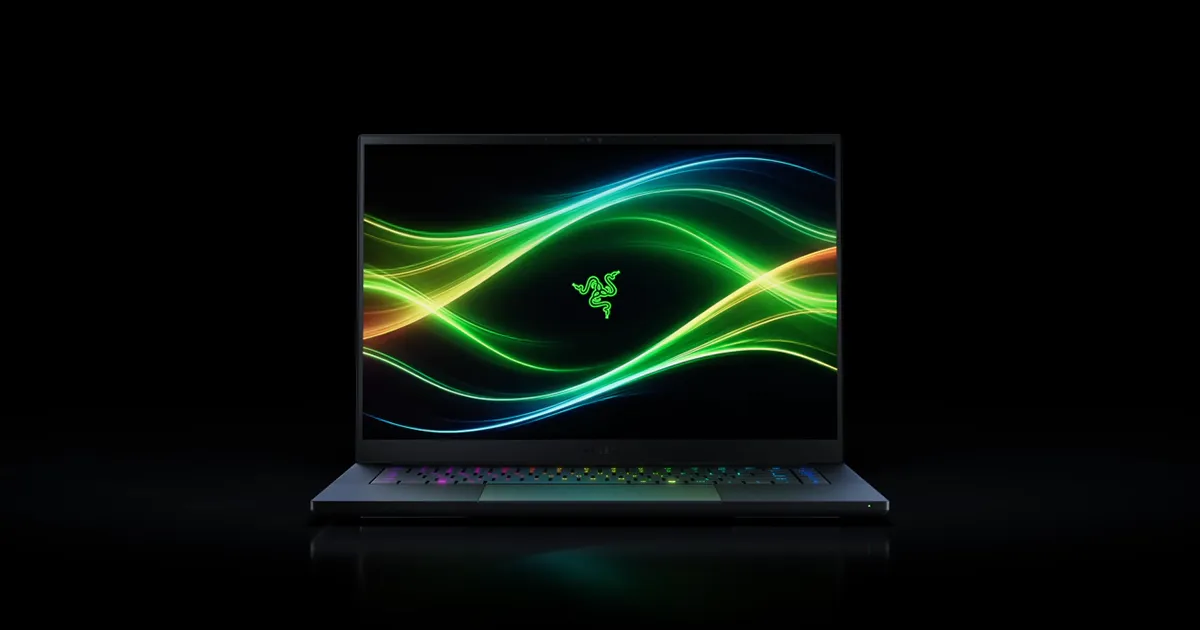
Two flagship-tier 16-inch gaming laptops from opposite ends of the price spectrum both landed in our test catalog this year: the Razer Blade 16 (2026) and the ASUS ROG Strix G16 (2025). On paper they compete for the same 16-inch, high-refresh, RTX 50-series buyer, but a $1,600 price gap separates them, and that gap buys more than just a badge. We put the two side by side to figure out exactly what the premium gets you, and whether it's worth paying.
The hardware, side by side
The Blade 16 pairs an Intel Core Ultra 9 386H with an NVIDIA GeForce RTX 5070 Ti laptop GPU, 32GB of soldered LPDDR5X-9600 memory, a 1TB NVMe SSD, and a 16-inch QHD+ (2560x1600) OLED panel running at 240Hz. The Strix G16 counters with an AMD Ryzen 9 9955HX3D, a one-tier-lower RTX 5070 with 8GB of GDDR7, 16GB of upgradeable DDR5-5600 memory (expandable to 64GB), the same 1TB of NVMe storage, and a 16-inch 2.5K (2560x1600) IPS panel at the same 240Hz refresh rate, backed by G-Sync. Both chase the same resolution and refresh target, but reach it through very different components.
GPU tier: RTX 5070 Ti vs. RTX 5070
This is the most direct performance gap between the two. The Blade 16's RTX 5070 Ti sits a full tier above the Strix G16's RTX 5070, translating into meaningfully higher sustained frame rates in demanding titles at native QHD+ resolution, particularly with ray tracing enabled. The Strix G16 isn't underpowered by any means — the RTX 5070 comfortably drives its 2.5K panel in most games — but buyers chasing the absolute highest settings at the highest resolution will feel the Blade 16's GPU advantage in benchmark charts and in practice.
Display: OLED contrast vs. IPS speed-per-dollar
Razer's OLED panel is the single biggest reason to consider the Blade 16 over the Strix G16. True per-pixel blacks, richer color, and the same 240Hz refresh rate the Strix G16 offers on IPS mean the Blade 16 doesn't trade contrast for speed — it gets both. We cover this exact tradeoff in more depth in our OLED vs. IPS buying guide, but the short version is that IPS still wins on price-per-nit and is immune to burn-in concerns, while OLED simply looks better in mixed and dark content. The Strix G16's IPS panel with G-Sync is a genuinely strong display in its own right — this isn't a case of one panel being bad, just less premium.
Memory: 32GB soldered vs. 16GB upgradeable
The two take opposite approaches to memory. Razer ships 32GB of fast LPDDR5X-9600 as a fixed, soldered configuration — generous today, but a hard ceiling for the life of the machine. ASUS ships a more conservative 16GB out of the box but leaves it user-upgradeable to 64GB, meaning a Strix G16 buyer who needs more memory down the line can add it rather than being stuck. Neither approach is wrong; it depends on whether you'd rather have more memory on day one or the option to add more later.
Battery, weight, and everyday usability
The Blade 16 carries an unusually large 95.2Wh battery, a direct response to how power-hungry a bright OLED panel and an RTX 5070 Ti can be — without it, real-world unplugged time would suffer. The Strix G16's 90Wh cell is only slightly smaller in absolute terms, but the less power-hungry IPS panel and lower-tier GPU mean the two end up closer in practical battery life than the raw capacity numbers suggest. Both are 16-inch gaming chassis first, portability second, so neither is the pick for someone prioritizing all-day unplugged use.
Build quality and thermals
Razer's CNC-milled aluminum unibody is a genuine step up in perceived build quality, with minimal deck or lid flex and a design restrained enough to look at home outside a gaming context. The Strix G16 leans into a more overt gaming aesthetic, with RGB lighting and styling that telegraphs what it is. Cooling an RTX 5070 Ti in the Blade 16's chassis is the harder engineering task, and Razer's thermal solution holds sustained clocks well under load, though fan noise is noticeable — a similar story to the Strix G16, which also runs its fans hard under full gaming load.
Storage, ports, and everyday expandability
Both ship with a 1TB PCIe NVMe SSD as the base configuration, but the Blade 16 stands out for including a second, user-accessible M.2 slot alongside the primary drive — meaning the starting 1TB can be expanded later without replacing the original drive, a genuinely useful option at a price point where buyers reasonably expect room to grow. As full-size 16-inch chassis, neither laptop compromises heavily on connectivity the way thinner ultrabooks often do; expect a full complement of USB-C, USB-A, and HDMI outputs on each, with the Blade 16 additionally including a UHS-II SD card reader that's a nice bonus for anyone who also shoots photo or video and wants to offload cards without a dongle.
Price and who should actually buy which
At $3,499, the Blade 16 costs $1,600 more than the $1,899 Strix G16 — an 84% premium. That premium buys a GPU tier bump, an OLED panel instead of IPS, more memory out of the box, and noticeably better perceived build quality, but it does not buy proportionally more gaming performance; the RTX 5070 Ti is faster than the RTX 5070, not nearly twice as fast. Buyers who want the best possible display and don't mind paying flagship prices for the last 10-15% of performance and polish should buy the Blade 16. Buyers who want nearly the same gaming experience — 240Hz at 2.5K/QHD+, a capable RTX 50-series GPU, and expandable memory — for roughly half the money should buy the Strix G16 and put the savings toward a second SSD or a better monitor for desktop use.
Our verdict
Neither laptop is a bad buy; this is a comparison between "excellent value flagship" and "no-compromises flagship," not good versus bad. The Strix G16 is, dollar for dollar, the stronger value proposition for most buyers, delivering the vast majority of the gaming experience the Blade 16 offers at a fraction of the price. The Blade 16 earns its premium primarily through its OLED display and the polish of its all-metal chassis, and it's the right pick specifically for buyers who've already decided panel quality is non-negotiable. Either way, both machines back their positioning with hardware that delivers on it rather than a spec sheet that only impresses on paper.