Lenovo LOQ Tower 17IRH11 (2026)
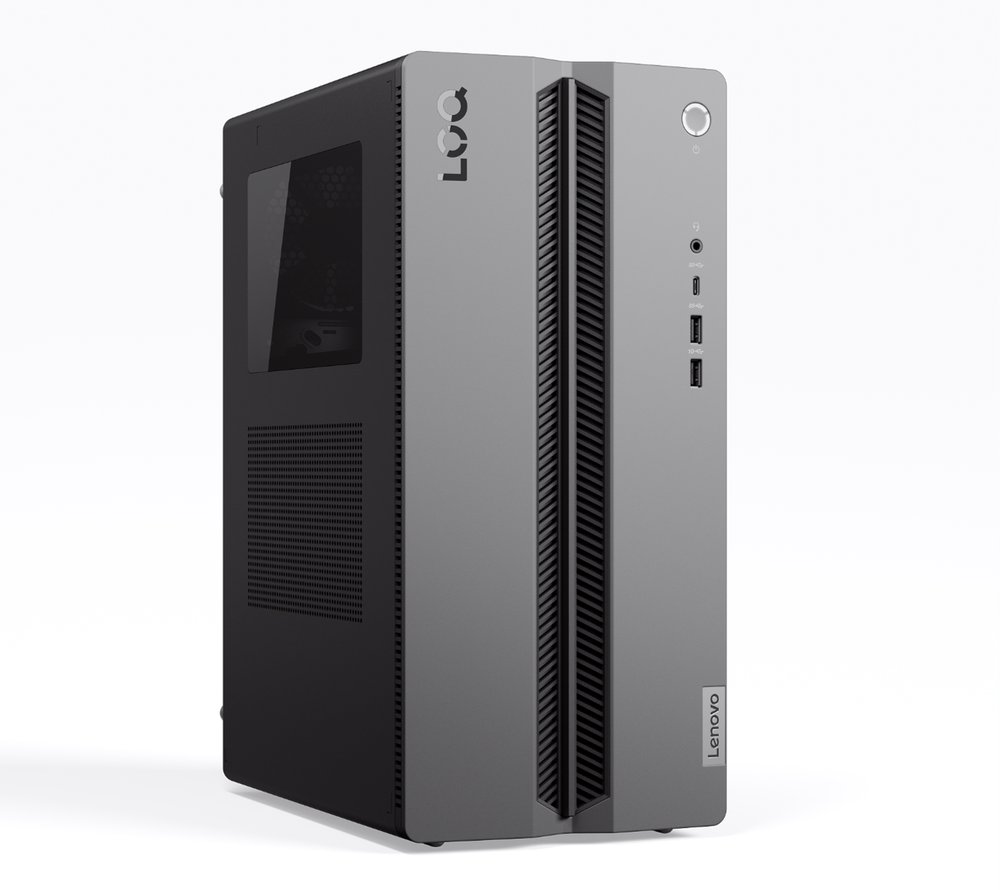
Lenovo's entry gaming tower for 2026: a 17-litre case with up to an Intel Core 7 230H, an RTX 5060 Ti with 8GB of GDDR7, tool-less Easy Upgrade Access, Wi-Fi 7 and a concealed air duct for quieter cooling.
Specifications
| CPU | Up to Intel Core 7 230H (Intel Core 200 series) |
|---|---|
| GPU | Up to NVIDIA GeForce RTX 5060 Ti desktop, 8GB GDDR7, up to 759 AI TOPS |
| RAM | Up to 32GB (2x16GB) DDR5, 5200 MT/s in spec table (5600 MT/s in press text) |
| Storage | Up to 1TB M.2 2280 PCIe Gen4 SSD, additional internal storage expansion |
| Power supply | Up to 500W, 92% efficiency |
| Ports | Front: USB-A 10G, USB-A 5G, USB-C 5G; rear: 4x USB-A, 1G LAN, HDMI 2.1 |
| Wireless | Up to Wi-Fi 7 with Bluetooth 5.4 |
| Chassis | 17L, 170 x 280 x 370 mm, from 6.08 kg, Raven Black with Luna Grey bezel |
| Audio | Nahimic Audio for Gamers, 5.1 surround |
| OS | Windows 11 |
Lenovo announced the LOQ Tower 17IRH11 on 25 August 2026, alongside two LOQ Essential laptops and two Legion monitors, in a release aimed at gamers who are just starting out. The message is that LOQ is the accessible entry point into PC gaming, while the Legion line covers enthusiasts, creators and competitive players as their ambitions grow. The tower is described as a ready-to-play system with room to grow for new PC gamers who want the performance of a desktop without the complexity of building one from scratch. This page collects what Lenovo has published, notes where its release and its specification table disagree, and explains who should look at it.
Positioning and price
Lenovo does not give a price for the tower. The release says only that pricing and availability will vary by region and to contact a local Lenovo representative, whereas it gives US estimated starting prices for the two laptops (October 2026 availability). For that reason this page has no price. The release is headlined as new LOQ Essential PCs and covers the tower, and Lenovo describes the Essential configurations as the most accessible in the LOQ range, but it does not say whether the tower itself carries the Essential label. Either way the framing points to a mainstream rather than premium price, although Lenovo does not put a number on it.
Core hardware
The release says the tower is powered by Intel Core 200 series processors and up to NVIDIA GeForce RTX 5060 Ti graphics. The specification table is more precise: the processor is listed as up to an Intel Core 7 230H, on a board labelled Intel RPL-H GT0. The graphics entry reads NVIDIA GeForce RTX 5060 Ti Desktop GPU with 8GB of GDDR7 and up to 759 AI TOPS. The table lists only the 8GB version, and the release does not state the memory size of the card, so 8GB is the number to plan around. If you are wondering whether that is enough for the games you play, our VRAM guide explains how memory demands change with resolution and texture settings.
Memory is where Lenovo's two documents disagree. The release says up to 32GB of 5600MT/s DDR5, and the table says up to 32GB in two 16GB modules at 5200MT/s. Both agree on the 32GB ceiling, and the footnote attached to memory and storage says only that the usable amount is less than the nominal figure because the operating system and software take a share. Lenovo does not resolve the speed difference. Take 32GB as the confirmed maximum and treat 5200 versus 5600 as unresolved until you see the configuration you order.
Storage is up to 1TB on an M.2 2280 PCIe Gen4 SSD. The release also mentions additional internal storage expansion, which implies room for more drives, but it does not say how many bays or connectors there are. Power comes from a supply of up to 500W with 92 percent efficiency according to the table. Wireless is up to Wi-Fi 7 with Bluetooth 5.4, described in the release as a practical foundation for a growing library and a more connected setup.
Ports
The specification table lists three front ports: one USB 3.2 Gen 2 Type-A at 10Gbps, one USB 3.2 Gen 1 Type-A at 5Gbps and one USB 3.2 Gen 1 Type-C at 5Gbps. The rear has two USB Type-A ports labelled Gen 2 but with a speed of 480Mbps, two USB 3.2 Gen 1 Type-A ports at 5Gbps, one 1Gbps Ethernet port, one HDMI 2.1 port and an audio output. The 480Mbps figure is the speed of USB 2.0, so the Gen 2 label on those two ports looks like an error in the table; I would trust the speed and treat them as USB 2.0-class. The table does not list the graphics card's own display outputs, which will depend on the card fitted. Audio is Nahimic Audio for Gamers with 5.1-channel surround sound.
Size and appearance
The tower is 17 litres, and Lenovo lists it as 170 by 280 by 370 millimetres, or 6.69 by 11.02 by 14.56 inches, starting at 13.4 pounds, about 6.08kg. Multiplying the dimensions gives a little over 17 litres, which is consistent. That makes it compact by tower standards and small enough to sit beside a monitor. The release says the design is dual-tone, and the table specifies a Luna Grey front bezel with a Raven Black chassis.
Cooling and upgrades
Lenovo says the tower uses a concealed air-duct design for quieter cooling, together with selectable thermal modes for balancing acoustics and performance. The release gives no decibel figure, no fan count and no temperatures, so those claims cannot be compared with anything and should be read as design intent. If noise is important to you, our quiet PC build guide explains how to interpret this sort of language.
The upgrade feature Lenovo emphasises is Easy Upgrade Access, a tool-less approach that it says makes it simpler to swap or add components as needs change. In a 17-litre case, what you can actually fit will be limited by the space inside, and Lenovo does not publish a maximum graphics card length or cooler height on the pages I read. If you expect to swap the graphics card later, check that first, and read our guide on which components age best in a PC for what usually matters most when planning upgrades.
Software
The release says Legion Space and Nahimic by SteelSeries round out the experience with software and audio support. Legion Space is Lenovo's gaming software; the release does not describe its functions for the tower. Lenovo's release also mentions AI-powered gaming tools through Legion Space in the context of the monitors, such as AI Crosshair and Game Companion for supported competitive scenarios, so I cannot say which of those tools apply to the tower. I have not seen any statement that they do.
What the release does not say
For a page that has to be useful to a buyer, it is worth listing what is missing. There is no price, no release date for the tower, no noise or temperature measurement, no GPU length limit, no count of storage bays and no information on the operating system edition beyond the table entry Windows 11. There are also no benchmark figures, and I have not tested the machine. The AI TOPS number is an NVIDIA-side figure for the graphics card and does not describe the gaming frame rates you will see.
Who it suits
The LOQ Tower is aimed at people who want their first gaming desktop without building one, in a small case with a current mid-range NVIDIA card and a straightforward upgrade path. If you want a much larger case, a bigger graphics card or a fully specified high-end processor, other products on this site suit you better; our page on the NZXT Player Two is a natural point of comparison for a prebuilt gaming tower, and our LOQ Tower versus Player Two comparison shows the specifications side by side. To weigh a prebuilt against building your own, read our prebuilt versus custom desktop guide. You can also browse the full desktop PC category.