ASUS ROG G700 (2025)
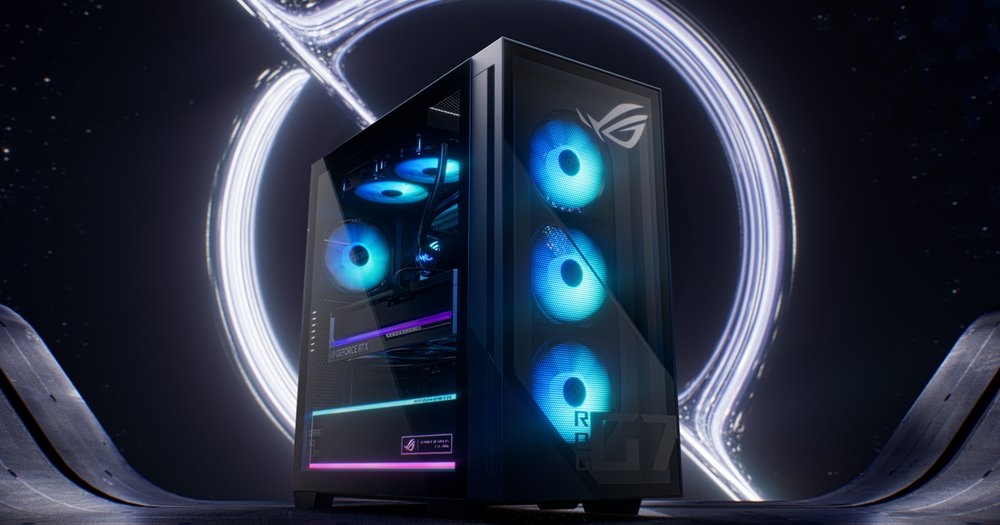
ASUS Republic of Gamers' first full-tower prebuilt built only from ROG and ASUS parts: a 58-litre glass chassis, four 65 CFM fans, tool-less panels and Intel or AMD platforms with up to an RTX 5090.
Specifications
| CPU | Intel Core Ultra 9 285K (G700TF) or AMD Ryzen 7 9800X3D (GM700TZ), up to |
|---|---|
| GPU | Up to NVIDIA GeForce RTX 5090 32GB GDDR7 (press); ROG spec page config lists RTX 5080 PRIME 16GB |
| RAM | 4x DDR5 U-DIMM slots, up to 64GB |
| Storage | 2TB PCIe 4.0 M.2 NVMe SSD, PCIe 5.0 supported; 2x M.2 2280, 4x SATA |
| Cooling | Air tower cooler or 240mm AIO; four 120mm case fans (65 CFM each, ASUS figure) |
| Power supply | 1000W 80+ Gold (press); 850W 80+ Gold on the listed RTX 5080 config |
| Ports | Front: 3x USB 5Gbps class, mic/headphone; rear up to USB 20Gbps Type-C (Intel), DisplayPort, HDMI (AMD) |
| Wireless | Wi-Fi 6, 2.5Gb Ethernet |
| Chassis | 58L full tower, glass front and side, tool-less panels, 24 x 50.92-51.04 x 47.96 cm, 18 kg |
| OS | Windows 11 Home or Pro |
ASUS Republic of Gamers announced the 2025 ROG G700 on 7 January 2025 in a press release datelined Taipei. The pitch is simple and unusually specific: a complete gaming desktop designed in-house, built exclusively from ROG and ASUS components, tested and validated by ASUS itself. That is an interesting proposition in a market where many prebuilt PCs are assembled from whatever parts a system integrator can source. This page walks through what ASUS says the machine contains, separates the numbers that appear in the launch release from the numbers that appear on the ROG product pages, and points out where the two disagree.
Two platforms, one chassis
The G700 comes in two families. The Intel version, listed as G700TF, uses a B860M MAX GAMING AX motherboard and goes up to an Intel Core Ultra 9 285K. The AMD version, listed as GM700TZ, uses a PRIME B650M-A AX6 II board and goes up to an AMD Ryzen 7 9800X3D. ASUS states that both can be paired with up to an NVIDIA GeForce RTX 5090 with 32GB of GDDR7. On the ROG specification page for one AMD configuration, the processor is described as a Ryzen 7 9800X3D at 4.7GHz with 96MB of cache, boosting to 5.2GHz, with 8 cores and 16 threads, on an AMD B650 chipset.
Memory is four DDR5 U-DIMM slots in dual-channel layout, with a stated ceiling of 64GB. The listed storage is a 2TB PCIe 4.0 M.2 SSD with a heatsink, and ASUS says the platform supports PCIe Gen 5 storage for a later upgrade. The AMD spec page adds useful detail about expansion: three PCIe 4.0 x16 slots and one PCIe 5.0 x16 slot, two M.2 2280 connectors and four SATA 6Gb/s ports. If you plan to grow a game library over several years, that combination of two M.2 sockets plus four SATA ports is the part of the spec sheet that matters most.
Where ASUS's own numbers disagree
Reading the launch release next to the product pages shows several differences that a buyer should know about, because they change what you actually get.
The first is the graphics card. The press release and the Intel feature page talk about up to an RTX 5090. The ROG specification page for the specific AMD configuration it lists, model code GM700TZ-R9800X031WS, shows an NVIDIA GeForce RTX 5080 PRIME with 16GB of GDDR7. Both statements can be true at once, because "up to" describes the ceiling of the range while the spec page describes one shipping configuration. The practical lesson is to check the exact model code before you buy.
The second is the power supply. The press specification table lists a 1000W ATX power supply rated 80+ Gold for both families, and the Intel feature page mentions a full-sized 1000W unit. The AMD configuration on the spec page lists an 850W 80+ Gold unit with a 900W peak. The most natural reading is that the power supply is sized to the configuration, with 1000W reserved for the top graphics options.
The third is networking. The press table says Wi-Fi 6 and Realtek 2.5Gb Ethernet. On the AMD spec page, the LAN row still says 2.5Gb, but the rear I/O list mentions a Realtek 1Gb Ethernet port. Because the same document contains both numbers, treat the 2.5Gb figure as the platform claim and confirm the port on your particular configuration.
The fourth is size and weight. The launch release gives 24 by 51.04 by 47.96 centimetres and 18kg, while the ROG spec page gives 24.00 by 50.92 by 47.96 centimetres and 18.00kg, adding that the dimensions exclude the chassis feet and the graphics card bracket. The difference in depth is roughly a millimetre, and ASUS says weight depends on configuration, so this is a rounding and measurement-basis issue rather than a real discrepancy. The feature page describes the chassis as a 58-litre design that can accommodate triple-slot graphics cards.
Cooling and airflow
ASUS puts most of its engineering story into airflow. Every G700 has four 120mm case fans: three intake fans on the front and one exhaust fan at the rear. Air-cooled models use a tower cooler for the processor, and liquid-cooled variants use a 240mm all-in-one cooler, which ASUS says offers the lowest processor temperatures and fan noise. On liquid-cooled builds, ASUS says two extra fans on the radiator exhaust hot air through the top panel. The feature page quotes a maximum airflow of 65 CFM per case fan, and says the fans use Loop Dynamic Bearings with a stated lifespan of up to 160,000 hours. Those are manufacturer figures and ASUS does not publish noise measurements alongside them, so they tell you what the fans are designed to do rather than how loud the finished PC will be.
The front panel is described as seamless, without drill holes, so air is drawn in from the sides through a hidden intake behind the glass. ASUS says there are dust filters on the top and bottom panels, and the press release says the system has three filters in total, all easy to remove and clean. The graphics card, where ROG's own model is fitted, is described as having Axial-tech fans, a large heatsink and a 0dB mode at light loads.
Design, access and upgrades
The chassis is the first ROG desktop to use glass on both the front and side panels, according to ASUS. It has both the ROG Slash and the Fearless Eye logo on the front, seamless gaps between frame and glass, and RGB that supports Aura Sync. ASUS also describes the styling as asymmetric and simple enough to sit in a professional setting as well as a gamer's den, which is a statement about taste rather than about specifications.
The practical design choice is tool-less access. The side panels come off without tools, and the release stresses that the motherboard, power supply and case fans are standard-sized parts. That matters for the long life of the machine, because you are not locked into a proprietary board or power supply. It also matches the advice in our article on the components that age best in a PC, where the ability to swap the graphics card, memory and storage independently is what extends a desktop's useful life.
Ports, sound and software
On the Intel configuration the front panel has two USB 5Gbps Type-A ports, one USB-C, a microphone jack and a headphone jack. The rear adds a DisplayPort, a 20Gbps USB Type-C port, a 10Gbps USB Type-A port, four 5Gbps USB Type-A ports, four USB 2.0 Type-A ports and three audio jacks that support 7.1-channel output. The AMD configuration lists a different mix: 10Gbps USB Type-A and Type-C, two 5Gbps Type-A ports, four USB 2.0 ports, DisplayPort and HDMI. Neither list mentions Thunderbolt or USB4.
Audio is 7.1-channel high-definition with ASUS Two-Way AI Noise-Canceling technology and Dolby Atmos support. On the software side, Armoury Crate provides monitoring and settings, Aura Creator and Aura Sync handle lighting across the chassis and compatible peripherals with 16 million colours, and the feature page says three months of PC Game Pass are included, with terms and regional exclusions. The operating system is Windows 11 Home or Pro depending on configuration; the feature page names Windows 11 Pro, while the AMD spec page lists Windows 11 Home Single Language and says ASUS recommends Pro for business use.
Memory speed and the AEMP claim
One more inconsistency deserves a note. The feature page says up to 64GB of DDR5 can run at 6000MHz with ASUS's AEMP II memory profile technology, while a comparison chart on the same page also lists plain DDR5 at 4800MHz. These are not contradictory. The 4800MHz figure is a baseline and the 6000MHz figure is a profile setting that depends on the memory kit actually fitted. The launch release says nothing about memory speed, so if it matters to you, look at the memory line of the configuration you intend to buy.
Price and recognition
The ROG feature page for the Intel G700 shows an ASUS store price starting at 1,049.99 dollars, reduced from 1,099.99 dollars at the time the page was captured. That is the entry configuration, and a top-end RTX 5090 build will cost far more, but ASUS does not list that figure on the pages I read. ASUS also states that the G700 won a 2026 Taiwan Excellence Award for design. The page carries short quotes from third-party media, which I have not reproduced, since I have not tested the machine or verified those reviews.
Who it suits
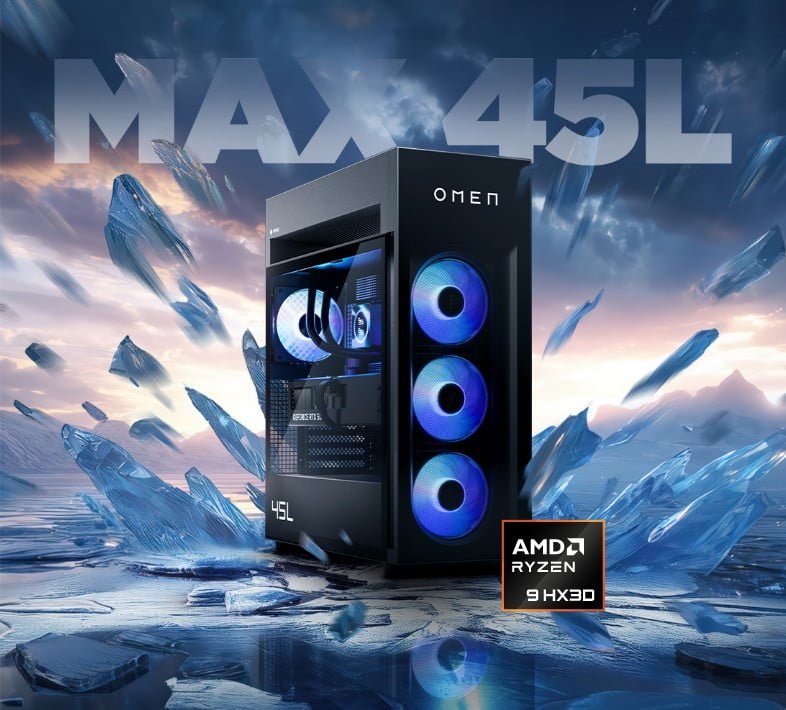
The G700 is aimed at gamers who want a big, easy-to-service desktop from a brand that also makes its own motherboards and graphics cards, and who prefer standard parts to a proprietary chassis. It is less obviously right for someone who wants Wi-Fi 7 or Thunderbolt, since ASUS lists Wi-Fi 6 and no Thunderbolt, and it is a large 18kg machine that needs a proper desk or floor space. For a direct comparison with a rival flagship prebuilt, see our ROG G700 versus OMEN MAX 45L comparison. If you are weighing a prebuilt against assembling your own, our prebuilt versus custom desktop guide covers the trade-offs, and the VRAM guide helps decide whether a 16GB or 32GB graphics card makes sense for your resolution. You can also browse the rest of our desktop PC category, including the compact NZXT Player Three for a smaller footprint.