Lenovo ThinkPad X1 Carbon Gen 13 Aura Edition (2024)
Lenovo's 14-inch business ultraportable from 980 grams: Intel Core Ultra 7 (Series 2), a 2.8K OLED panel, Thunderbolt 4, Wi-Fi 7 and a customer-replaceable battery.
Specifications
| CPU | Intel Core Ultra 7 (Series 2), NPU over 45 TOPS |
|---|---|
| GPU | Intel Arc Xe2 integrated |
| RAM | Up to 32GB LPDDR5x-8533 |
| Storage | Up to 2TB PCIe Gen5 SSD |
| Display | 14-inch 16:10 2.8K OLED, 100% DCI-P3, 400 nits, 120Hz |
| Battery | 57Wh customer-replaceable; over 18h claimed by Lenovo |
| Weight | From 980 g |
| Ports | 2x Thunderbolt 4, 2x USB-A, HDMI 2.1, combo audio jack |
| Wireless | Wi-Fi 7, Bluetooth 5.4, optional 5G sub-6 |
The ThinkPad X1 Carbon Gen 13 Aura Edition is Lenovo's flagship business ultraportable for the Intel Core Ultra (Series 2) generation. Lenovo introduced it on 5 September 2024 at its Innovation World event in Berlin and, according to the launch release, planned availability from November 2024, initially in a limited group of European markets. Its headline claim is weight: it starts at 980 grams, which Lenovo describes as the lightest ThinkPad X1 Carbon ever and less than one kilogram for a 14-inch flagship. This page reviews the specifications and features published in Lenovo's release, separates what Lenovo states as fact from what it presents as a claim and explains who this machine is for.
What Aura Edition means
The Aura Edition name is a software and experience layer developed together with Intel, and it applies to more than this one model. Lenovo says the concepts were shaped by qualitative and quantitative user testing with more than ten thousand participants around the world, followed by a further round with four thousand users. The result is a set of features called Smart Modes, reached through a widget. Lenovo lists four: Shield, which offers Privacy Alert and Privacy Guard against unwanted snooping and automatically launches a preferred VPN when you join a public Wi-Fi network; Attention, which helps reduce distraction with attention timers and silenced notifications; Collaboration, which optimises video performance and presets such as background blur and low-light enhancement; and Wellness, which offers posture alerts and break reminders to reduce eye fatigue. The release also mentions quick access to power-mode settings in the same app.
A Smart Care feature gives access to Lenovo's online support tools and a chatbot, and a higher Premier Support Plus tier is described as offering concierge-style help with remote camera sharing and voice or chat with Lenovo engineers around the clock. A related Smart Share function, which lets you tap a supported smartphone on the screen edge to move photos, is described in the release for the Yoga Slim 7i Aura Edition rather than for the ThinkPad. These are software conveniences, and their value depends on whether you would use them.
Processor, graphics and AI
The X1 Carbon Gen 13 uses an Intel Core Ultra 7 processor from the Series 2 family with Intel Arc Xe2 integrated graphics and an integrated NPU that Lenovo says offers more than 45 TOPS. Lenovo, quoting Intel, claims up to three times the AI performance of the previous generation on both the NPU and the GPU. It will support Copilot+ PC features when Microsoft makes them available, and it carries a dedicated Copilot key on the keyboard. That wording matters: the release says the machine will support Copilot+ features when available, so the feature list depends on Microsoft's software schedule rather than on the hardware alone. Our explainer on NPU and AI acceleration in laptops describes what a TOPS figure means in practice, and why it is a poor guide to everyday speed.
Memory is LPDDR5x at 8533 MT/s in a dual-channel arrangement, up to 32GB. Lenovo's specification table lists storage as a PCIe Gen5 SSD of up to 2TB. As with most thin laptops, low-power memory of this type is normally soldered to the board, so choose the capacity you need when ordering. The operating system is Windows 11 Pro.
Display
The display is a 14-inch 16:10 2.8K OLED panel with 100 percent DCI-P3 coverage, 400 nits, HDR True Black 500, Dolby Vision, Eyesafe low-blue-light certification and a switchable 120Hz refresh rate. Lenovo lists an anti-glare surface treatment and a screen-to-body ratio of 89.2 percent. In practical terms, an OLED panel offers deep blacks and vivid colour, which suits video, photo review and presentations. It also means that brightness, which is stated at 400 nits here, will be adequate indoors and less generous in strong daylight. Buyers who work in bright rooms should compare this figure with what they need.
Keyboard and input
Lenovo describes a backlit TrackPoint keyboard with a glass three-button trackpad, and an optional Haptic TouchPad that integrates the three TrackPoint buttons. The keyboard has ribbed keys as an accessibility feature according to the specification table. The TrackPoint, the red pointing stick, is a ThinkPad signature that many typists prefer because it keeps hands on the home row. An IR camera enables Windows Hello facial recognition, and there is a fingerprint reader. The camera is a full-HD with infrared unit and comes with a physical privacy shutter.
Ports and wireless
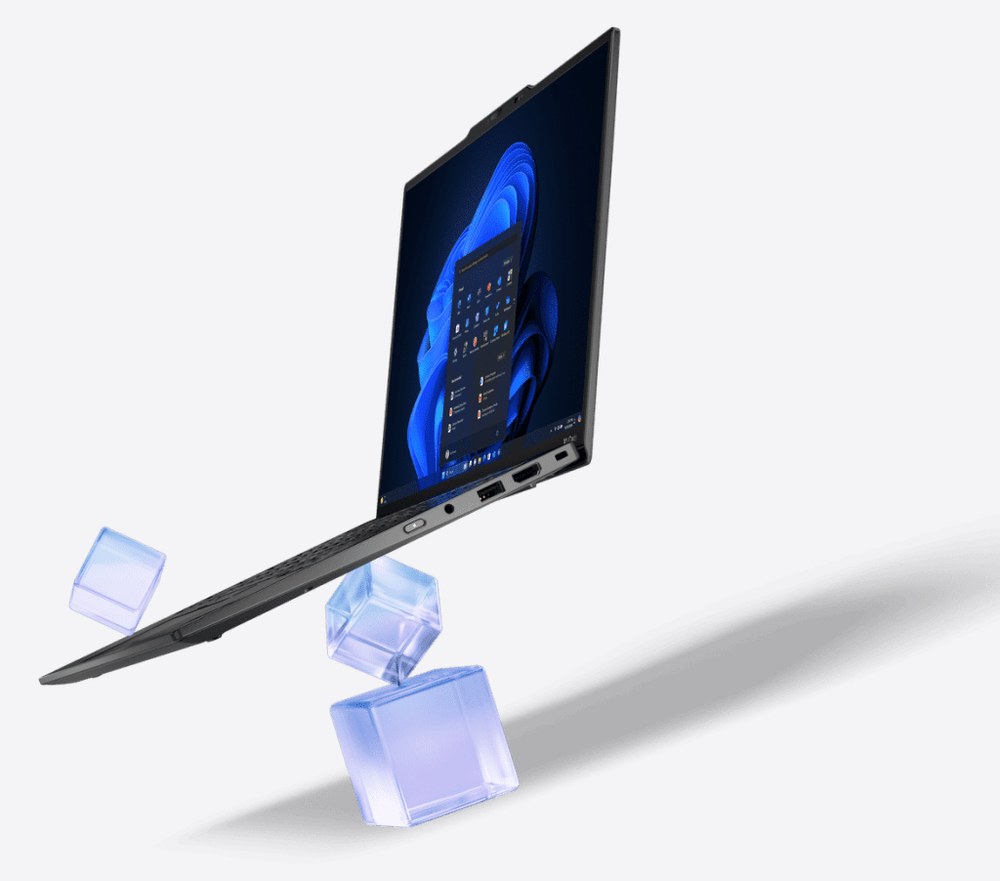
The port set is more traditional than on many thin laptops: two Thunderbolt 4 ports, two USB-A ports at 5Gb/s, one HDMI 2.1 output and a combined headphone and microphone jack. Wireless is Wi-Fi 7 and Bluetooth 5.4, with optional 5G sub-6GHz that Lenovo said would arrive in 2025. Keeping USB-A and full-size HDMI removes the need for many adapters at meetings and is a real strength for business travellers. The general trade-offs between port types are covered in our guide to laptop ports, Thunderbolt and USB4.
Battery and charging
The battery is 57 watt-hours and is a customer replaceable unit. Lenovo says it delivers more than 18 hours of battery life, a claim supported by a benchmark footnote in the release and not by everyday-use testing, so expect to get less with a bright OLED screen, video calls and background applications. The charger is a 65W GaN USB-C adapter. A user-replaceable battery is unusual in thin laptops and is a genuine advantage for long-term ownership and for fleet management, where a worn battery can be swapped without a workshop visit. For a broader look at how batteries and cooling interact, see our deep dive on laptop battery life and thermal throttling.
Design, weight and durability
The listed dimensions are 312.8 by 214.75 mm, with a thickness of 8.08 to 14.37 mm, and the weight starts at 980 grams. The A cover is carbon fibre and the C and D covers use 90 percent recycled magnesium. The machine is finished in Eclipse Black and Lenovo states it passes MIL-STD-810H testing, a US military test standard for environmental durability. Recycled content extends to 90 percent post-consumer recycled plastic in the speaker enclosure, battery frame and charger and 85 percent in the keycaps, and the packaging is plastic-free, made from bamboo and sugarcane. Lenovo lists EPEAT Gold and ENERGY STAR certification. These are manufacturer claims and certifications; verify them for your region if procurement rules depend on them.
Security and management
The security list includes Lenovo ThinkShield, a Firmware Shield, a touch fingerprint reader on the keyboard, IR facial recognition, a discrete TPM 2.0 chip, a webcam privacy shutter and a Nano Kensington lock slot. Combined with Windows 11 Pro, that gives IT departments a familiar checklist.
Price and availability
Lenovo's release listed European availability from November 2024, with limited availability in the United Kingdom, Germany, France, the Nordic countries and Switzerland, at an expected starting price of 2,699 euros excluding tax. Prices, configurations and markets change over time, so treat that as a launch figure rather than a current quote. The release does not state a US price.
Who should buy it, and how it compares
The X1 Carbon suits professionals who carry a laptop all day and value low weight, a familiar keyboard, real ports and business-grade security: consultants, managers, engineers and travellers. It is less suited to people who need discrete graphics, more than 32GB of memory or a bright outdoor screen. For a sense of how far the line has come, our page on the ThinkPad X1 Carbon 2nd generation from 2014 lists that model, and the comparison of the Gen 13 and the 2nd generation shows the decade of change. If you are weighing several thin designs, our roundup of the best ultraportable laptops lists the questions to ask, and you can browse the whole range on our laptops page.
Bottom line
The ThinkPad X1 Carbon Gen 13 Aura Edition is a well-specified, very light business laptop whose strengths are its weight, its OLED display option, its traditional ports and its replaceable battery. Its weaknesses are the ones typical of the category: limited graphics, soldered memory and a premium price. Lenovo's battery and AI claims rest on footnoted benchmarks and on software that arrives later, so judge the machine on the concrete specifications and use the claims as context rather than as promises.