ASUS Ascent QN10 (2026)
A 130mm square Windows mini PC on the Snapdragon X2 Elite: 18 Oryon cores, an 80 TOPS NPU, three USB4 ports, Wi-Fi 7 and 2.5G Ethernet in a case ASUS puts at under 0.7 litres.
Specifications
| CPU | Snapdragon X2 Elite X2E-88-100, 18-core 3rd Gen Qualcomm Oryon |
|---|---|
| GPU | Qualcomm Adreno X2-90 (integrated) |
| NPU | Qualcomm Hexagon, up to 80 TOPS |
| RAM | 16GB or 32GB LPDDR5x-8533/9600 |
| Storage | 512GB M.2 NVMe PCIe 4.0 SSD, supports 512GB to 1TB M.2 2280 |
| Ports | 3x USB4 40Gbps Type-C (DP 2.1/PD), 3x USB-A 10Gbps class plus USB 2.0, HDMI, 2.5G RJ45, audio jack |
| Wireless | Wi-Fi 7, Bluetooth 6.0 |
| Power supply | 180W (20V 8A) external adapter |
| Chassis | 130 x 130 x 39.96 mm, under 0.7L, 0.75 kg, silver |
| OS | Windows 11 Home, Copilot+ PC |
ASUS announced the Ascent QN10 on 17 September 2026 in a press release datelined Taipei, although the pressroom page itself carries the date 18 September. It is a mini PC built around the Qualcomm Snapdragon X2 Elite platform, and ASUS calls it the world's first AI mini PC with an 80 TOPS neural processing unit. That is a manufacturer claim about being first, which I cannot verify, but the underlying specifications are published on both the press release and the ASUS tech-spec page, and they are consistent enough to give a clear picture of what the machine is. This page covers those specifications, points out the places where the numbers deserve a second look, and sets out who might want a computer like this.
The platform
The press release says the QN10 uses the Snapdragon X2 Elite platform with an 18-core Qualcomm Oryon CPU. The specification page is more exact: Snapdragon X2 Elite X2E-88-100, third-generation Qualcomm Oryon CPU with 18 cores. Graphics are integrated, a Qualcomm Adreno X2-90, which ASUS says delivers 2.3 times the performance of the previous generation. The NPU is the Qualcomm Hexagon, rated by ASUS at up to 80 TOPS. ASUS says this exceeds the requirements for Copilot+ PCs, and the specification page lists Windows 11 Home Copilot+ PC as the operating system.
Memory is 16GB or 32GB of LPDDR5x, listed as 8533 or 9600MHz. The page uses megahertz rather than the usual mega-transfers per second, so I reproduce the numbers as printed. ASUS does not say on the pages I read whether the memory is soldered or replaceable, so do not assume you can upgrade it. Storage is a 512GB M.2 NVMe PCIe 4.0 SSD in the base configuration, and the page says the slot supports 512GB up to 1TB in M.2 2280 format on PCIe 4.0 x4. That 1TB ceiling is worth noting, since a mini PC used for local AI models can fill a drive quickly.
Size, weight and power
The case is 130 by 130 by 39.96 millimetres, or 5.12 by 5.12 by 1.57 inches, and weighs 0.75kg. Multiplying the dimensions gives about 0.675 litres, which agrees with ASUS's statement of under 0.7 litres and with its claim of being 86 percent smaller than a conventional 5-litre desktop, since 0.675 divided by 5 is roughly 13.5 percent. The colour is silver. ASUS describes sustained performance with cool and quiet operation and low power consumption but gives no noise figure, no power measurement and no temperature data, so those points are description rather than evidence.
Power comes from an external adapter labelled 20V, 8A, 180W. Those numbers do not multiply out: 20 volts at 8 amps is 160 watts. I cannot tell from ASUS's pages whether the 180W figure refers to a peak rating, a rounded value or a labelling slip. It is a small point, but it is the kind of detail that matters if you are replacing an adapter or planning a power budget for a desk with several devices.
Ports and networking
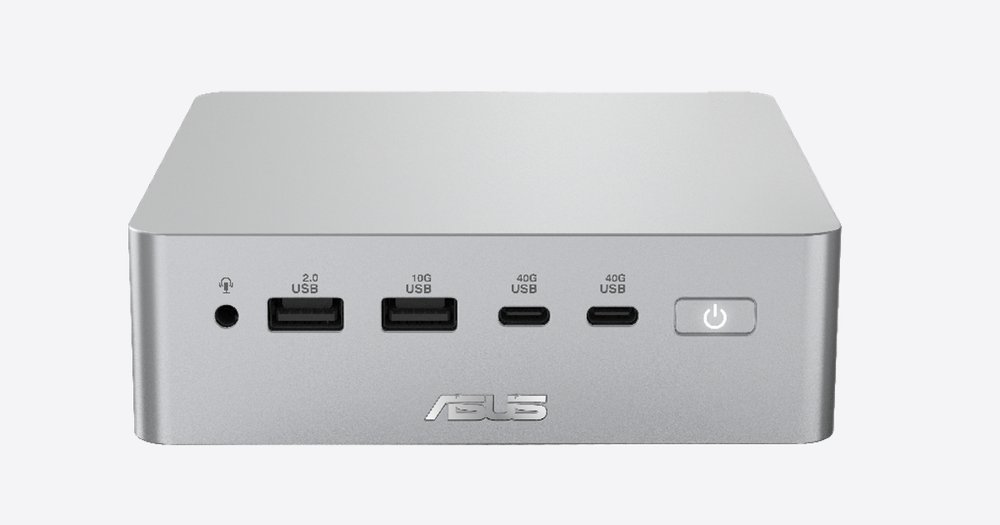
The QN10 has a generous port set for its size. On the front there is one USB 2.0 Type-A, one USB 3.0 Gen 2 Type-A at 10Gbps, two USB4 Gen 2 Type-C ports at 40Gbps with DisplayPort 2.1 and power delivery, and a combined microphone and headphone jack. On the back there are two USB 3.2 Gen 2 Type-A ports at 10Gbps, one more USB4 Type-C port at 40Gbps, an HDMI port, an RJ45 Ethernet port and the DC input. That gives three USB4 ports and four Type-A ports in total, plus one HDMI, so a multi-monitor desk is possible using the USB4 ports for DisplayPort output, although ASUS does not state how many displays or what resolutions the machine supports. The specification page has a typo in one line, printing "10Gbpd", which I read as 10Gbps.
Wireless is Wi-Fi 7 (which ASUS labels Gig+) and Bluetooth 6.0, and wired networking is 2.5G Ethernet listed as 10, 100, 1000 and 2500Mbps. The press release says this connectivity supports cloud synchronisation and collaborative workflows.
Security features
ASUS describes a multi-layered security architecture across hardware, firmware, the operating system and the cloud. The named features are fTPM 2.0 for hardware-rooted credential and encryption protection and the Microsoft Pluton security processor for identity and key protection and for always-connected device management and recovery. ASUS labels this chip-to-cloud security. I have no independent information on how these are configured by default, so treat it as a manufacturer description. The specification page also lists certification marks including BSMI, CB, CE, FCC, UL, Energy Star, C-Tick, WiFi, RF and VCCI, which varies by region.
The AI story
Most of the release is about on-device AI. ASUS mentions real-time language translation, content generation, video enhancement, AI assistants and workflow automation as example uses of the NPU. For developers, it says the QN10 can access the Qualcomm AI Hub, a developer site that simplifies model optimisation, validation and deployment, which ASUS says offers more than 175 pre-optimised models and supports bringing your own model and your own data. ASUS also describes hybrid agentic workflows that combine on-device processing with cloud intelligence, naming OpenClaw and Hermes Agent as supported agent frameworks and WhatsApp and LINE as ways to talk to agents. Workloads are routed between cloud language-model APIs and the local NPU to balance performance, responsiveness, power and cost.
These are capabilities rather than measurements. ASUS gives no benchmark for language-model speed, no memory limit for local models beyond the 16GB and 32GB options, and does not discuss software compatibility for applications written for other processor architectures, which is a question worth asking before buying if you rely on specific programs. For a plain-language explanation of what an NPU does and where TOPS figures mislead, see our article on NPUs and AI acceleration in 2026.
Where it fits
The QN10 belongs to the same broad class as other tiny desktops. Apple's Mac mini with M6 starts at 899 dollars in the US according to Apple, and ASUS's own ROG NUC takes a very different, gaming-oriented approach. ASUS has not published a price for the QN10 on the pages I read, and it does not give an availability date, so there is no price to put on this page. Our QN10 versus ROG NUC comparison lines up the specifications. For readers interested in small-form-factor computing generally, our mini-ITX small form factor build guide explains the trade-offs of going small, and the full desktop category has more options.
Who it suits
The QN10 makes sense for a developer who wants to run and test local AI workflows on a Windows machine with an 80 TOPS NPU, for an office or studio that wants a tiny, low-footprint desktop with plenty of USB4, or for an edge deployment where space and power matter. ASUS itself names creators, developers and enterprises. It is less obviously right for someone who wants a gaming PC, upgradeable memory or a discrete graphics card, since the machine has integrated graphics and ASUS does not list upgrade options beyond the SSD. Until ASUS publishes a price and independent testing appears, the sensible approach is to treat the QN10 as an interesting specification sheet.