Apple Mac mini (M6 / M5 Pro, 2026)
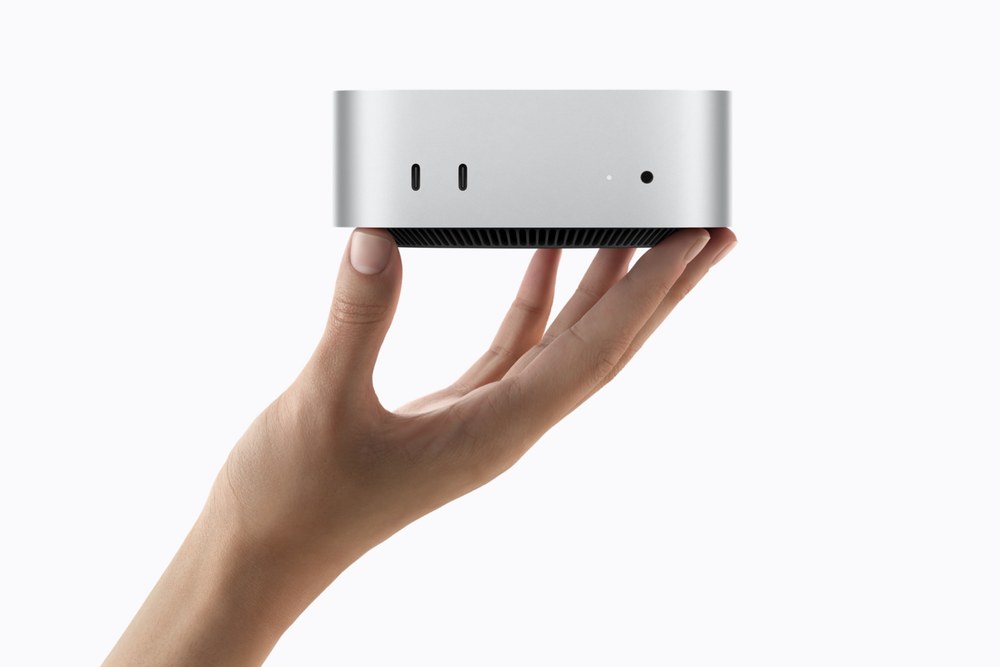
Apple's ultracompact desktop with the new M6 or the M5 Pro: a 12-core CPU and GPU with Neural Accelerators, Wi-Fi 7, 2.5Gb Ethernet and Thunderbolt 5 on the Pro model.
Specifications
| CPU | M6 12-core or M5 Pro up to 18-core |
|---|---|
| GPU | 12-core (M6) / up to 20-core (M5 Pro) with Neural Accelerators |
| RAM | 16GB up to 32GB (M6, 170GB/s) / up to 64GB (M5 Pro, 307GB/s), unified |
| Ports | Front: 2x USB-C, headphone jack. Rear: 3x Thunderbolt 4 (M6) or 3x Thunderbolt 5 (M5 Pro), HDMI, Ethernet |
| Networking | Wi-Fi 7, Bluetooth 6, 2.5Gb Ethernet (10Gb option) |
| OS | macOS 27 |
Apple announced a new Mac mini on 25 August 2026 in two chip options, the all-new M6 and the M5 Pro. Pre-orders opened that day, and the machine started reaching customers on 22 September. It stays the smallest desktop in Apple's range and, in Apple's words, the most versatile Mac, aimed at home users, students, small businesses, creative professionals and people who want a quiet box that runs all day. This page collects the facts Apple has published, flags the places where a claim is a comparison rather than a measurement and helps you decide between the two chips.
The two versions and their prices
The Mac mini with M6 starts at 899 dollars in the US, or 799 dollars with education pricing. The Mac mini with M5 Pro starts at 1,699 dollars, or 1,599 dollars for education. Apple offers configure-to-order options for chip, memory and storage on both. The 800-dollar gap is a lot of money for a small box, so it is worth understanding what it buys.
M6: what is inside
The M6 has a 12-core CPU, two more cores than the previous chip, which Apple says delivers the world's fastest single-threaded performance. The GPU has 12 cores, also two more than before, and each GPU core includes a Neural Accelerator for the first time on a Mac mini. Apple adds an all-new Dual 16-core Neural Engine that it says is up to twice as fast as the previous generation. Memory starts at 16GB of unified memory and is configurable to 32GB, with memory bandwidth of up to 170GB/s.
Apple's headline numbers compare the M6 with the M4 Mac mini: up to 4 times faster AI performance, up to 2 times faster graphics and storage, and 40 percent faster CPU performance. The examples in the release give more context. It quotes up to 13.5 times faster language-model prompt processing in LM Studio compared with the M1 Mac mini and 4.8 times faster than the M4 model; up to 2.3 times faster spreadsheet calculation in Microsoft Excel than the M1 and 1.5 times faster than the M4; and up to 2 times faster ray-traced gaming performance in Cyberpunk 2077 than the M4 model. Look at how the multipliers differ. The AI number is the largest because the Neural Accelerators target exactly that workload, while the everyday spreadsheet gain of 1.5 times is closer to what most people will notice when switching from last year's model.
M5 Pro: the step up
The Mac mini with M5 Pro has up to an 18-core CPU and up to a 20-core GPU with enhanced shader cores and third-generation ray tracing. It supports up to 64GB of unified memory with 307GB/s of bandwidth, which Apple says allows larger local AI models, more complex 3D scenes, ProRes RAW editing and large datasets. Apple compares it with the M4 Pro and with the older M2 Pro Mac mini: up to 4 times faster language-model prompt processing than the M4 Pro (8.5 times faster than the M2 Pro), up to 1.4 times faster ray-traced rendering in Blender than the M4 Pro (4.5 times faster than the M2 Pro) and up to 1.5 times faster image processing in Affinity than the M4 Pro (2.1 times faster than the M2 Pro). Again the gap between the AI gain and the ordinary gains is wide.
Ports and networking
This is where the two models differ in ways that matter to a desktop. Both have two USB-C ports on the front that support USB 3 and a headphone jack with high-impedance headphone support. On the back, the M6 model has three Thunderbolt 4 ports, while the M5 Pro model has three Thunderbolt 5 ports; both have HDMI and Ethernet. Both models now have Wi-Fi 7 and Bluetooth 6, and both step up from Gigabit to 2.5Gb Ethernet, with a 10Gb Ethernet option available at configuration. Apple also mentions genlock support over USB-C, which synchronises a display with a camera, including the iPhone 17 Pro.
Thunderbolt 5 has another use in Apple's release: it lets several Mac mini systems be clustered to run large AI models entirely on the device. That is an unusual desktop feature, and it points to how Apple wants people to use this box: as a small server in the corner, not only as a workstation. If you have no need for very fast external storage, a Thunderbolt 5 dock or clustering, the Thunderbolt 4 ports on the M6 are ample.
An always-on machine
Apple repeatedly describes the Mac mini as suited to always-on, deskside AI work, for example running agents that automate tasks or serving a local model. Two properties support that claim. The chips have what Apple calls industry-leading performance per watt, which keeps power draw and noise low, and the case is tiny. Apple's release does not publish idle or sustained power figures, so I would not quote a wattage. If low noise and low power matter to you, our article on building a quiet PC describes what to look for in any small desktop.
Software
The machine is presented with macOS 27, called Golden Gate, and Apple's next Apple Intelligence generation including Siri AI. In the launch release the system was described as upcoming with a public beta, and Apple's later availability notice described it as recently released. If you buy now, check that the version shipping matches your needs. As usual, Apple states the software features have regional and language limits.
Size, materials and what is missing
The material I reviewed does not include dimensions or weight, so I will not quote them; check Apple's technical specifications. Apple says the enclosure uses 100 percent recycled aluminium and all magnets use recycled rare earth elements, that the machine contains 50 percent recycled material overall and that all electricity used in manufacturing comes from renewable sources, with matching renewable investment for customer use. These are company claims.
What is missing is what a mini always lacks: it comes without a display, keyboard or mouse, and memory and storage are fixed at purchase. If you are used to swapping RAM and drives in small-form-factor PCs, this is a different proposition. Our page about building with Mini-ITX and small form factor parts shows the opposite approach, where you choose and upgrade parts yourself. For an upgrade-focused view, the piece on which PC components age best is a useful counterpoint, because on the Mac mini nothing can be upgraded later.
Choosing between the chips and the previous model
Choose the M6 if your work is web, office, communication, media playback, coding and light creative work, plus curiosity about running local AI models. It is the version most people should buy. Choose the M5 Pro if you edit video, work with large photo or audio projects, do 3D, develop games or run bigger local models, and if you value Thunderbolt 5. Add the 10Gb Ethernet option if you use a fast network-attached storage device.
If you are deciding against last year's machine, our page on the Mac mini with M4 gives its specifications, and the comparison of the M6 and M4 models lines the two up. Windows users who want a small box with a discrete graphics chip should look at the ROG NUC 2025, which is larger, uses laptop-class graphics and has replaceable memory and storage, a very different approach to small desktops.
Bottom line
The 2026 Mac mini is a meaningful update: two more CPU cores, a GPU with Neural Accelerators, faster storage, Wi-Fi 7, 2.5Gb Ethernet and, on the M5 Pro, Thunderbolt 5. Its price starts at 899 dollars, and its limits are unchanged: no user upgrades and no included peripherals. Treat Apple's multipliers as comparisons against older Apple chips, weigh the everyday gains more than the AI headline unless you run local models, and pick the chip that matches your heaviest realistic task.