Apple Mac Studio (M5 Max / M5 Ultra, 2026)
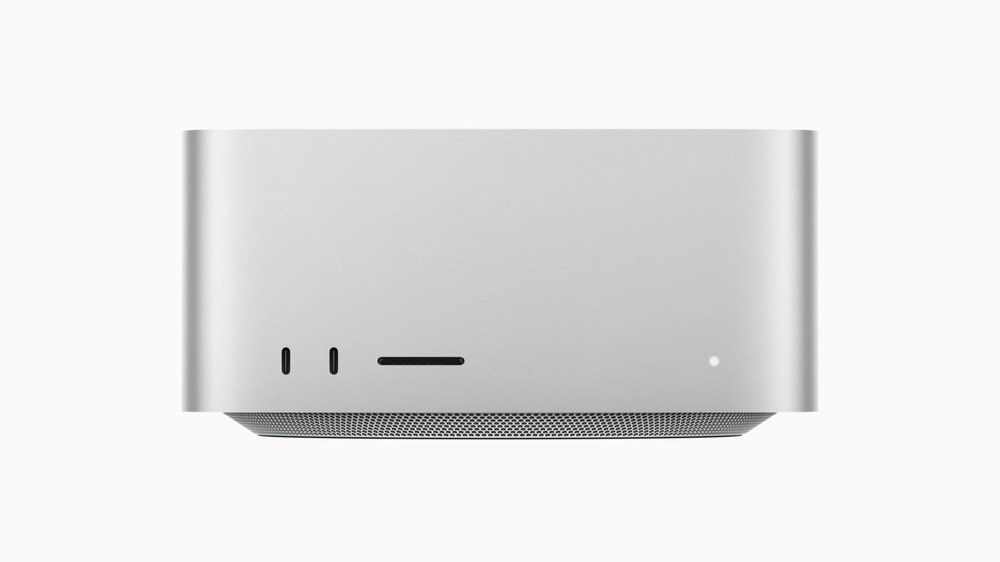
Apple's compact desktop workstation with the M5 Max or the new M5 Ultra: up to 80 GPU cores, up to 512GB of unified memory, six Thunderbolt 5 ports and Wi-Fi 7.
Specifications
| CPU | M5 Max 18-core (6 super + 12 performance) or M5 Ultra up to 36-core |
|---|---|
| GPU | Up to 40-core (M5 Max) / up to 80-core (M5 Ultra) with Neural Accelerators |
| RAM | Up to 128GB (M5 Max) / up to 512GB (M5 Ultra) unified, up to 614GB/s / 1.2TB/s |
| Ports | Up to 6x Thunderbolt 5 |
| Wireless | Wi-Fi 7, Bluetooth 6 (Apple N1) |
| Displays | Up to 8 displays |
| OS | macOS 27 |
On 25 August 2026 Apple announced a new Mac Studio built around the M5 Max and an all-new chip, the M5 Ultra. Pre-orders opened that day and the machines went on sale on 22 September, with the 512GB memory configuration promised for late October. It keeps the compact desktop form of earlier Mac Studio models and, according to Apple, becomes its most powerful Mac. This page summarises what Apple has published, points out where the claims are comparisons rather than measurements you can reproduce, and explains who needs a machine like this.
Two chips, two price tiers
The Mac Studio with the M5 Max starts at 2,499 dollars in the US (2,299 dollars for education) and the version with the M5 Ultra starts at 5,499 dollars (5,099 dollars for education). Apple also offers a leasing programme for eligible US customers, with the M5 Max model from 48.99 dollars a month over 36 months and the M5 Ultra model from 110.10 dollars a month. The wide gap between the tiers matches the chips.
The M5 Max has an 18-core CPU made of 6 super cores and 12 performance cores, and a GPU of up to 40 cores with a Neural Accelerator in each core. It supports up to 128GB of unified memory and up to 614GB/s of memory bandwidth. The M5 Ultra scales that up to a CPU of up to 36 cores (12 super cores and 24 performance cores) and a GPU of up to 80 cores, which Apple calls the most powerful GPU it has made and the first Ultra chip to include Neural Accelerators. The memory goes up to 512GB with 1.2TB/s of bandwidth, described by Apple as 50 percent more than before.
Reading Apple's performance claims
Apple's headline is that the new Mac Studio delivers up to 4.3 times faster AI performance, up to 2 times faster storage, up to 1.8 times faster graphics and up to 1.3 times faster CPU speed. The release's footnotes tie those numbers to specific comparisons, so they need careful reading. The 4.3 times figure refers to peak AI compute of the M5 Ultra compared with the M3 Ultra, and Apple says it is 9.8 times that of the M1 Ultra. For the M5 Max it claims up to 3.9 times the AI performance of the previous generation.
The application examples give a clearer picture. With the M5 Max, Apple lists up to 3.9 times faster language-model prompt processing in LM Studio than the M4 Max, up to 3.5 times faster text-to-image generation, up to 3 times faster Magic Mask in DaVinci Resolve Studio and up to 1.9 times faster DNA basecalling in Oxford Nanopore MinKNOW. With the M5 Ultra it lists up to 3.3 times faster CopyCat machine-learning training in Foundry Nuke than the M3 Ultra, up to 4 times faster prompt processing, up to 4.3 times faster image generation and up to 1.7 times faster Maxon Redshift rendering. Traditional rendering gains of around 1.4 to 1.7 times are more typical of an ordinary generational step; the eye-catching multipliers are for AI workloads that use the new GPU hardware.
Memory and why 512GB matters
The Mac Studio's argument for local AI is memory capacity. Because the CPU and GPU share one pool, a model that would not fit in the video memory of a typical discrete graphics card can be loaded whole. Apple says 512GB of unified memory with 1.2TB/s of bandwidth lets users run very large open-weight language models entirely on the device, without cloud costs, and with privacy. That is a manufacturer claim about capability, not a promise about speed for any given model; a very large model can fit and still run slowly if the workload demands more compute than the chip provides.
The trade-off is that unified memory is fixed at purchase. The top memory configuration arrives later than the rest, so buyers who need it should plan for the delivery date Apple gave. Our guide on how much VRAM you need explains why the GPU memory question matters for AI work, and the article on how much RAM you need covers the general sizing rules.
Clustering with Thunderbolt 5 and RDMA
A notable feature is clustering. Apple says multiple Mac Studio machines can be joined over Thunderbolt 5 with remote direct memory access, which lets the systems form a larger shared memory pool. It states that a cluster of four systems delivers up to 3 times faster AI inference than a single one and that this enables the largest open-weight models to be loaded. This is aimed at teams and researchers, and it comes with an obvious caveat: the multiplier depends on the model and the software framework, and Apple gives no details beyond the footnote. Apple also names its new Core AI framework and its open-source MLX framework as the tools for building and deploying models on the platform.
Connectivity and displays
Apple lists up to six Thunderbolt 5 ports at up to 120Gb/s, which it positions for fast external storage, PCIe expansion chassis and hubs. Wi-Fi 7 and Bluetooth 6 arrive for the first time in a Mac Studio through Apple's N1 wireless chip. The machine also supports genlock over USB-C, which synchronises a display with a professional camera such as the iPhone 17 Pro, and it supports up to eight displays, or up to four Studio Display XDR panels at full 5K resolution and 120Hz. The release does not list the remaining ports, dimensions or weight in the material I reviewed, so consult Apple's technical specifications for those before you plan your desk.
Media engine and creative work
The M5 Max Media Engine supports hardware-accelerated H.264, HEVC, ProRes and AV1 decode, and Apple says it allows filmmakers to colour-grade uncompressed 8K footage and process several video streams at once. The M5 Ultra has twice as many video encode and decode blocks as the M5 Max and can, according to Apple, play up to 33 streams of 8K ProRes 422 at 30 frames per second at the same time. Third-generation hardware ray tracing and improved shader cores are meant to speed up 3D and VFX viewports and offline renders.
Software and support
The machine is presented with macOS 27, which Apple calls Golden Gate, and a next generation of Apple Intelligence with Siri AI. The launch release described the operating system as upcoming, while Apple's later availability notice described it as recently released, so a machine bought after 22 September should ship with or be able to run it. Apple also lists 35 percent recycled content overall, 100 percent recycled aluminium in the enclosure and 100 percent recycled rare earth elements in all magnets.
Who should buy it, and who should not
The Mac Studio suits people who want workstation-class power in a small, quiet box that sits on the desk: colourists and editors, 3D and VFX artists, audio engineers, developers who compile large codebases, and researchers who run or fine-tune models locally. The M5 Max is the sensible choice for most of them. The M5 Ultra is for those whose work is limited by GPU compute or memory capacity in a way they can measure today.
It is a poor fit for anyone who wants to upgrade components over time. Memory and storage are fixed, there are no internal expansion slots, and the machine does not include a display, keyboard or mouse. Buyers who need expansion cards should look at the Mac Pro, which offers PCIe slots, although it uses an older chip. If you are considering a conventional tower instead, the article on prebuilt versus custom desktop PCs discusses the trade-off between a sealed system and a build you can upgrade.
The previous generation remains a useful reference. Our page on the Mac Studio from 2025 lists its specifications, and the side-by-side comparison of the 2026 and 2025 models helps you judge whether the newer chips justify the price. You can browse related machines on our desktops page.
Bottom line
The 2026 Mac Studio is a serious answer to the demand for on-device AI and high-end creative work: larger memory, a GPU with Neural Accelerators, faster storage and up to six Thunderbolt 5 ports, in a compact case. Its weak spots are the ones any sealed system has, plus a high price for the M5 Ultra. Apple's multipliers compare against Apple's previous chips and specific applications, so measure your own workload before paying for the top tier.