ASUS ROG Zephyrus G16 (2024)
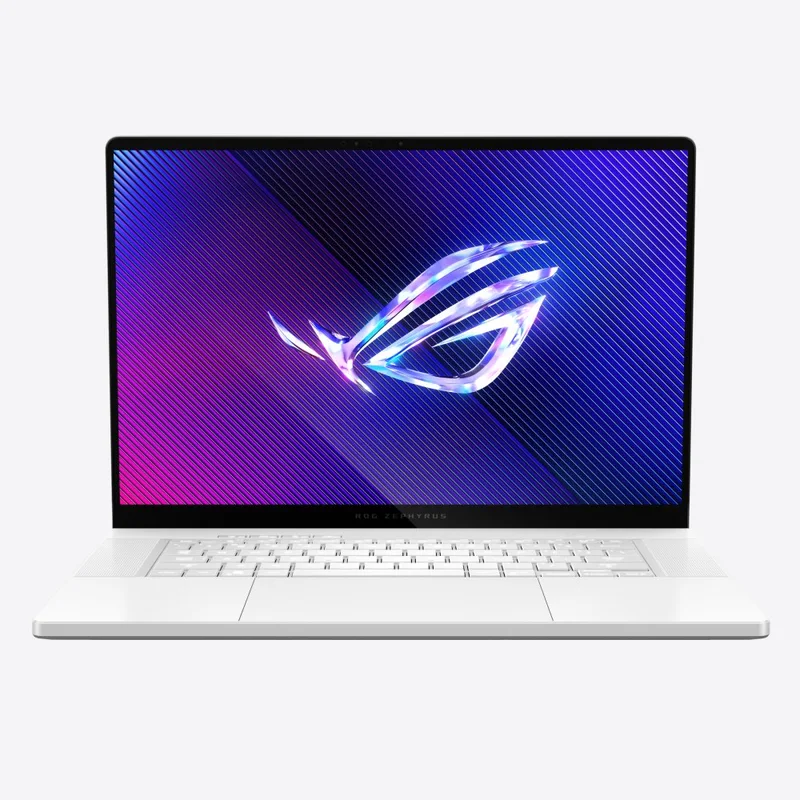
The redesigned 2024 Zephyrus G16: a CNC aluminium 16-inch body, 240Hz OLED or IPS-level screen, Core Ultra 7 or 9 and RTX 4050 to 4090 graphics.
Specifications
| CPU | Intel Core Ultra 7 155H or Core Ultra 9 185H (16-core), NPU up to 11 TOPS |
|---|---|
| GPU | NVIDIA GeForce RTX 4050 up to RTX 4090 Laptop GPU (up to 115W) |
| RAM | 16GB or 32GB LPDDR5X-7467 (soldered) |
| Storage | Up to 2TB PCIe 4.0 NVMe SSD, 2x M.2 slots |
| Display | 16-inch 2.5K (2560x1600) 240Hz, OLED or IPS-level, G-Sync |
| Battery | 90Wh |
| Weight | 1.85 kg / 1.95 kg |
| Ports | Thunderbolt 4, USB-C 3.2 Gen 2, 2x USB-A 3.2 Gen 2, HDMI 2.1, SD UHS-II, 3.5mm combo jack |
| Wireless | Wi-Fi 6E, Bluetooth 5.3 |
The ROG Zephyrus G16 (2024), model GU605M, was the year ASUS rebuilt its 16-inch premium gaming laptop from the ground up. It moved to an all-aluminium, CNC-machined chassis, introduced the Slash Lighting array on the lid, added Intel's first Core Ultra processors with an on-chip NPU, and offered a 2.5K 240Hz display in both OLED and IPS-level versions alongside NVIDIA GeForce RTX 40 series graphics from the RTX 4050 to the RTX 4090. Its successor, the 2025 model, changes the processor and graphics, but the 2024 machine remains a capable laptop and, because it has been on the market for longer, it can be worth considering. This page sets out the specification ASUS publishes, what it means in use, and how to think about the choice between generations.
Chassis and design
ASUS says the body is built from 6063 aluminium alloy, milled from a solid block using CNC machining. The finishing follows an eight-step process, and channels for the keyboard, touchpad and speakers are cut with 0.7 mm tools so that the parts sit edge to edge. Every keyhole, and the vents beside them, is milled individually. The intent is a body that keeps its rigidity even though it is thin: ASUS lists dimensions of 35.4 by 24.6 cm with a height of around 1.49 to 1.74 cm depending on the version, and a weight of 1.85 kg or 1.95 kg.
The 2024 model is where the Slash Lighting array first appeared on the G16. It is a bold diagonal strip of light segments across the lid, which ASUS describes as an evolution of the brand's earlier lighting and inspired by science fiction and contemporary art. It can be customised through the Armoury Crate software. The machine is designed to look more like a premium work laptop than a traditional gaming one, and that suits people who carry it into offices, classrooms and cafes. For readers unsure whether a 16-inch laptop is the right size, our guide to 13, 14 and 16 inch screens is a good starting point.
Display options
The G16 (2024) is available with two 16-inch 2560 by 1600 (2.5K) panels in a 16:10 shape. The IPS-level ROG Nebula Display runs at 240Hz with a stated 3 ms response time, covers 100 percent of DCI-P3, is Pantone validated and supports G-SYNC. The OLED version keeps the 240Hz refresh rate but lists a 0.2 ms response time, and ASUS quotes an OLED contrast ratio in the region of one million to one. Both have an anti-glare, low-reflection surface, and a MUX switch with NVIDIA Advanced Optimus lets the machine use the discrete GPU directly for games.
The choice between the two is a matter of priorities. OLED offers true black and a wide colour range that flatters video and photography, but it comes with the general OLED caution about static images staying on screen for very long periods; ASUS includes protective features such as pixel shifting. The IPS-level panel is more conventional. If you are trying to judge how much a high refresh rate matters, our explainer on refresh rates from 60Hz to 360Hz gives useful context.
Processor and NPU
The processors are the Intel Core Ultra 7 155H and the Core Ultra 9 185H. The 155H has 16 cores and 22 threads with a boost up to 4.8 GHz, and the 185H has 16 cores and 22 threads with a boost up to 5.1 GHz, both with 24 MB of cache and an Intel AI Boost NPU rated at up to 11 TOPS. ASUS describes the NPU as suited to sustained AI workloads while reducing power consumption, which can help battery life. For a plain-language look at what those NPUs do in daily use and where the marketing outruns reality, read our piece on NPUs and AI acceleration in laptops.
Graphics options
Graphics choices run from the GeForce RTX 4050 with 6 GB of GDDR6 to the RTX 4060 and RTX 4070 (8 GB), the RTX 4080 with 12 GB and the RTX 4090 with 16 GB. ASUS lists ROG Boost power levels between 100 W and 115 W including Dynamic Boost, and gives AI performance figures that range from 194 TOPS for the RTX 4050 to 686 TOPS for the RTX 4090. The machine also supports NVIDIA Studio drivers for creative applications and NVIDIA DLSS. Because these are power-limited laptop parts, they perform below the desktop cards that share their names. Our explainer on laptop versus desktop GPUs covers that difference.
Memory, storage and ports
Memory is soldered LPDDR5X-7467, in 16 GB or 32 GB. ASUS states that no memory expansion is possible, so the capacity you choose is fixed for the life of the laptop, a limitation discussed in our note on soldered versus upgradeable RAM. Storage is a PCIe 4.0 NVMe SSD of up to 2 TB, and the board has two M.2 PCIe slots.
The ports are a 3.5 mm combo audio jack, an HDMI 2.1 FRL output, two USB 3.2 Gen 2 Type-A ports, a USB 3.2 Gen 2 Type-C with DisplayPort and power delivery, a Thunderbolt 4 port with DisplayPort and power delivery, and a UHS-II SD card reader that photographers and videographers will value. The machine also supports ROG's XG Mobile external graphics dock. Wireless is Wi-Fi 6E with Bluetooth 5.3, which is a step behind the Wi-Fi 7 of the newest models, and there is no built-in Ethernet port. A 1080p infrared camera supports Windows Hello for face login.
Cooling and sound
ASUS describes a set of measures that were new for the 2024 model: second-generation Arc Flow fans, a redesigned high-efficiency air outlet, a dual-exhaust heatsink and a new fibre-and-mesh heatpipe design that it says is 23 percent more efficient than the older groove-and-powder type. Liquid metal thermal compound is used on the processor, and certain models also feature a custom vapor chamber or a Tri-Fan design in which a third auxiliary fan sends heat from the processor and graphics to the exhaust. A dust filter protects the intakes. Modes are Silent, Performance and Turbo, plus Manual, and in Silent mode the fans can stop entirely for light tasks.
The speakers were also upgraded. ASUS says the new woofers produce a 47 percent increase in volume and reach bass down to 100 Hz, in a four-speaker system with two woofers and two tweeters and Dolby Atmos support. A three-microphone array works with two-way AI noise cancelling. The battery is 90 Wh, and chargers of 200 W, 240 W and a 100 W USB-C unit are listed, depending on the configuration. As with the newer model, ASUS publishes a battery test method but no runtime, so we do not quote hours; read our deep dive on battery life and thermal throttling for how to judge these machines yourself.
2024 or 2025?
The successor, the ROG Zephyrus G16 (2025), keeps the same dimensions and weight range, and moves to the Intel Core Ultra 9 285H, RTX 50 series graphics up to the RTX 5090, LPDDR5X of up to 64 GB and Wi-Fi 7. If you want the newest hardware, and particularly if you need more than 32 GB of memory or more than 16 GB of video memory, the newer model is the better pick. If you can find the 2024 version at a substantially lower price, it still offers the same chassis, screen options and ports as its successor. Creators should also look at our guide to the best laptops for content creators, and the two generations can be viewed side by side on ROG Zephyrus G16 (2024) versus ROG Zephyrus G16 (2025). The rest of our range is in the laptops category.