HP OMEN MAX 45L (2025)
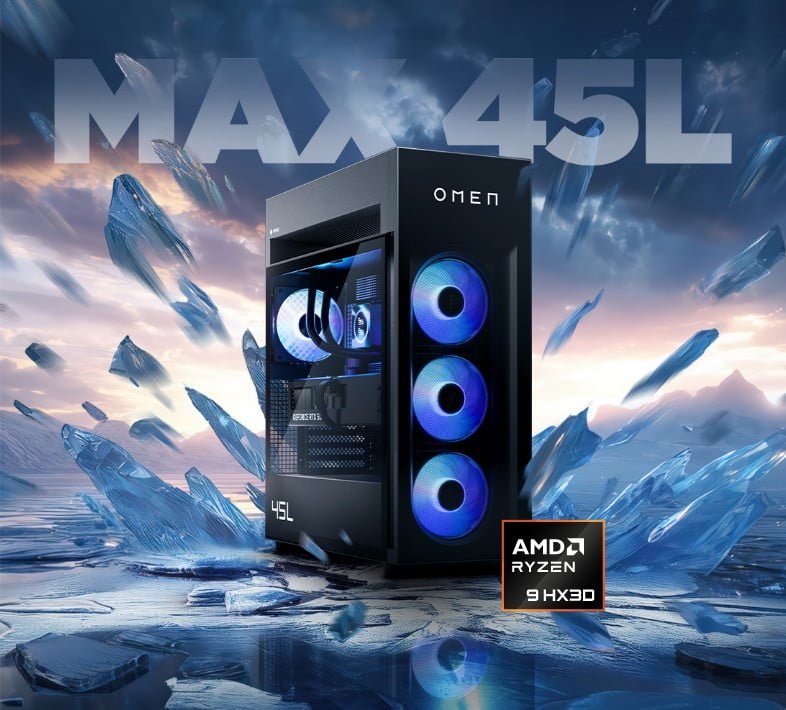
HP's most powerful gaming desktop: the OMEN MAX 45L pairs up to a Ryzen 9 9950X3D and RTX 5090 with a 360mm liquid cooler mounted in a separate Cryo Chamber above the case.
Specifications
| CPU | Up to AMD Ryzen 9 9950X3D (16 cores, 5.7GHz max boost, 128MB cache, 170W) |
|---|---|
| GPU | Up to NVIDIA GeForce RTX 5090 32GB GDDR7 or 5090D; AMD Radeon RX 9070 XT 16GB also listed |
| RAM | Up to 128GB DDR5-5200 (4x32GB) or 64GB DDR5-6000 (2x32GB), Kingston FURY |
| Storage | Up to 4TB PCIe Gen4 NVMe M.2 SSD (page headline says Gen5) plus 2TB 7200rpm HDD |
| Cooling | Patented Cryo Chamber, 360mm liquid cooler with LCD cap, self-cleaning fans |
| Power supply | Up to 1200W modular ATX 3.1 (80 Plus Gold in spec list, Platinum in headline) |
| Ports | USB-C 10Gbps, 2x USB-A 5Gbps, Thunderbolt 4 40Gbps (DP 2.1), headphone/mic combo |
| Wireless | MediaTek MT7925 Wi-Fi 7, Bluetooth 5.4 |
| Chassis | 8.03 x 18.50 x 21.85 in, 49.82 lb, glass front, tool-less |
| OS | Windows |
HP unveiled the OMEN MAX 45L on 14 August 2025 at its first Level Reforge event in Los Angeles and describes it as the most powerful gaming desktop in its OMEN range. A follow-up HP Tech Takes article dated 3 September 2025 says it would be available in December 2025, and the launch release says pricing would be announced closer to availability. I could not find a list price on the pages I read, so this page carries none. What HP does publish is a detailed component list, a patented cooling layout and a set of thermal test footnotes, and those footnotes are where the most interesting reading is.
The core hardware
HP's product page lists a top configuration built around the AMD Ryzen 9 9950X3D: 16 cores, a 5.7GHz maximum boost clock, 128MB of cache and a 170W rating. The Tech Takes article describes it as combining Zen 5 with 3D V-Cache technology. For graphics, the page lists up to an NVIDIA GeForce RTX 5090 with 32GB of GDDR7, or the 5090D, and it also names an AMD Radeon RX 9070 XT with 16GB of GDDR6 among the components. The case is listed as fitting graphics cards up to 335mm long.
Memory goes up to 128GB of Kingston FURY DDR5-5200 in four 32GB modules, or 64GB of DDR5-6000 in two 32GB modules, with EXPO profiles. HP presents these as two different choices rather than a single spec: the bigger kit gives more capacity, the smaller kit a higher rated speed. Storage is listed as up to 4TB of PCIe Gen4 NVMe M.2 plus a 2TB 7200rpm hard drive. Wireless is a MediaTek MT7925 with Wi-Fi 7 and Bluetooth 5.4, and the case has one PCIe Gen5 x16 slot and one Gen4 x4 slot.
Conflicts inside HP's own material
Three details differ between HP documents, and it is worth knowing which is which.
Storage generation: the Tech Takes article says the machine has an ultra-fast PCIe Gen5 SSD, and the headline banner on the product page says up to 4TB PCIe Gen5, but the detailed specification line on the same page says up to 4TB PCIe Gen4 NVMe. The detailed line is the more specific statement, so treat Gen4 as the confirmed figure for the drives in the specification list and Gen5 as a capability of the platform.
Power supply: the Tech Takes article calls it a 1,200W modular unit, and the launch release calls it OMEN's first fully modular 1200W supply. The product page banner says up to 1200W Platinum certified, while the detailed line says a 1200W 80 Plus Gold certified PCIe5 ATX 3.1 modular unit. Gold and Platinum are different efficiency tiers, so if efficiency matters, check the configuration you are ordering.
Cooling claim: the launch release says the Cryo Chamber delivers a 7.5 degree Celsius reduction in full-load temperatures. The product page words it as up to 7.5 degrees cooler than leading competitor dual-chamber models. The Tech Takes FAQ says the radiator draws ambient air that runs up to 10 degrees cooler than air inside the case. These three sentences do not describe the same comparison, which is why the footnote matters, as explained below.
How the Cryo Chamber works, and what the 7.5 degrees means
The idea is to take the radiator out of the main chamber. HP places the 360mm liquid cooler in a separate chamber above the main case, so it draws air from outside the chassis rather than from the warm air around the graphics card and drives. The cooler has three fans and an LCD cap that shows temperatures, speeds and animations. HP calls the design patented and says the heat from the processor is moved out quickly instead of sitting in the main case.
Now the footnote. HP's internal thermal test, described in the launch release, compares a 2024 OMEN 35L with a 2025 OMEN MAX 45L, both with a Ryzen 9 9950X3D, 240mm liquid cooling, an RTX 5080, 64GB of DDR5-6000, two 2TB drives and a 1200W supply, using a Prime95 plus 3DMark full-load run at 25 degrees ambient. The 35L reached 86.5 degrees and the MAX 45L 79 degrees, a difference of 7.5. So the headline number is a comparison against the previous, smaller OMEN 35L, on HP's own test bench, not an independent measurement against rivals. A second footnote covers the graphics card: a 2024 OMEN 45L with a 360mm cooler and RTX 5090 reached 78.9 degrees against 77 degrees for the MAX 45L, a difference of about 1.9 degrees, which HP rounds to up to 2. HP credits raised feet, open bottom vents and vented expansion slots for that small gain.
Self-cleaning fans and maintenance
The Tech Takes article introduces self-cleaning fans with a reversible function. At the push of a button they briefly reverse to expel dust and debris from the blades. The modular power supply has a matching cleaning mode, custom fan curves and real-time monitoring in OMEN Gaming Hub. The chassis uses tool-less side panels and brushed metal with tempered glass, and HP says clean cable management makes component swaps quick.
Overclocking and software
HP's product page describes Extreme Mode, a setting in OMEN Gaming Hub that lets you raise CPU performance without entering the BIOS, and says safeguards prevent permanent damage. Whether that is a benefit depends on how comfortable you are with overclocking a chip that already boosts to 5.7GHz. OMEN AI, which HP says launched at CES 2025, is described as a one-click tool that applies personalised performance settings, and the launch release lists support for Valorant, League of Legends, Apex Legends and Fortnite. Light Studio in OMEN Gaming Hub controls RGB across the fans, memory and the LCD cap.
Connectivity and physical size
The front lists a USB-C port at 10Gbps, two USB-A ports at 5Gbps and a headphone and microphone combo jack. A second list, which appears to cover the rear, has another 10Gbps USB-C, two 5Gbps USB-A ports and one Thunderbolt 4 port at 40Gbps with DisplayPort 2.1 output. The chassis measures 8.03 by 18.50 by 21.85 inches and weighs 49.82 pounds according to HP, and weight varies with configuration. Converted, that is roughly 20 by 47 by 55.5 centimetres and 22.6kg. Multiplying the exterior dimensions gives about 53 litres, so the 45L in the name evidently does not describe the outside envelope; HP does not define it on the pages I read.
Performance claims to read carefully
HP's marketing says the RTX 5090 offers up to twice the performance of the RTX 4090 with DLSS 4 in titles such as Cyberpunk and Black Myth: Wukong, and the Tech Takes article says you can play at true 4K with every setting maximised and full ray tracing without dropping a single frame. Those are manufacturer and marketing statements, not measurements I have made, and the second one is the kind of absolute claim that no specification sheet can guarantee. HP also says the system suits 3D rendering, 8K video editing and generative AI models because of the ample video memory. Treat these as descriptions of intent.
Who it is for
The MAX 45L is aimed at buyers who want the largest, most thermally generous OMEN and are willing to pay for a flagship. HP says it targets performance seekers who need to run several demanding applications at once. If a slightly smaller and cheaper machine is enough, the same launch also introduced the OMEN 35L, which shares the 1200W modular supply according to the release. If you prefer a flagship from ASUS, see the ROG G700, or compare HP's approach directly with Dell's in our OMEN MAX 45L versus Alienware Area-51 comparison. Noise is the trade-off with high-power cooling, and our quiet PC build guide explains what to look for. To judge whether a prebuilt like this beats a self-built tower, read the prebuilt versus custom guide, and for how desktop graphics differ from mobile chips, see laptop GPU versus desktop GPU explained.